Places
Myloi (the village)
179 events
Show on a map (opens in a new tab)
-
130–199
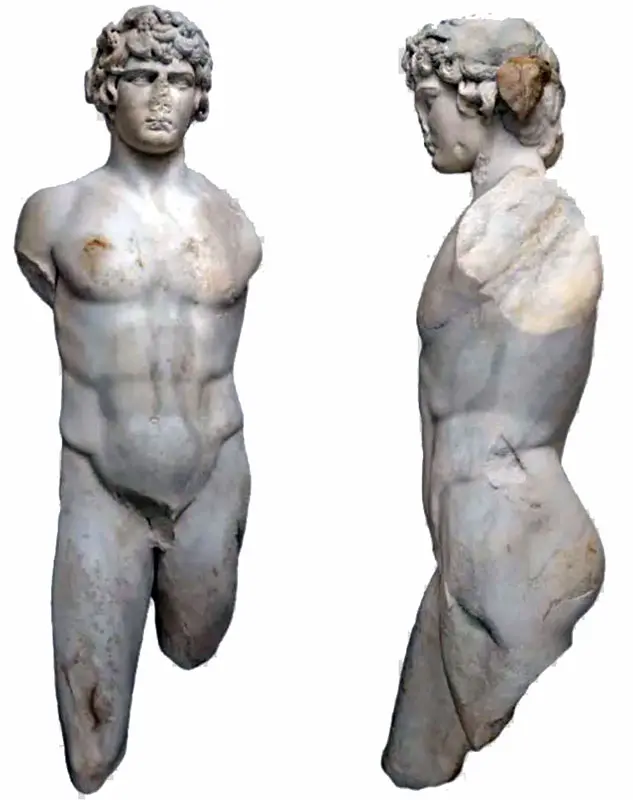
A statue of Antinoos in a sanctuary near Lerna
After Antinoos, the young favourite of Emperor Hadrian, drowned in the Nile in 130 AD and was declared a god, statues of him were set up across the empire. One of them, slightly larger than life and crowned with ivy like…
-
1696
1696: 42 souls in 11 houses
A Venetian church census of 1696 counts 42 people, all locals, in 11 houses at "Kiveri". In Venetian papers this name usually means the part of Kiveri facing Nafplio, the later Myloi, but the identification is not…
-
1700
1700: ten families and nine working mills
The Venetian land register of Argos, made for governor Francesco Grimani in 1700, lists for "Civeri": 7 local and 3 newly settled families, one Greek church, 12 state houses, 20 ruined houses and 9 working water mills.…
-
1704
'Molini': the village appears under its own name
In his description of the Peloponnese, printed in Venice in 1704, P. A. Pacifico lists the 29 villages of the territory of Argos. Next to 'Civeri' he names a separate village 'Molini', the Mills. This is the oldest known…
-
1804–1806
Gell: the lake has become a mill dam
The English topographer William Gell, who travelled the Morea in 1804–1806, wrote that the ancient Alcyonian lake 'is now become a species of mill dam', turning mills 'which give the name of Myli to the spot'. 'There are…
-
19 July 1809
Tithe wheat goes from Myloi to Tripolitsa
A tax account dated 7 July 1809 (old style) records 'the wheat that was taken from Myloi to Tripolitsa' in the name of Nikolos Meletis, at 30 para a measure. It was the tithe wheat of the district of Argos, from 52…
-
c. 1815
Pouqueville: about thirty houses at the foot of Pontinos
The French consul and traveller François Pouqueville arrived after sunset and, once someone had fetched the key, spent the night in the khan on bare planks, plagued by mosquitoes. 'Lerna or Milos', he wrote, consisted of…
-
1822–1826
A German volunteer describes fortified Myli
The philhellene Gottfried Müller from Bremen wrote that Myli had several long houses along the sea and a former Turkish garden with a high wall, which the Greeks had turned into a stronghold. The spring drove a mill with…
-
July 1822
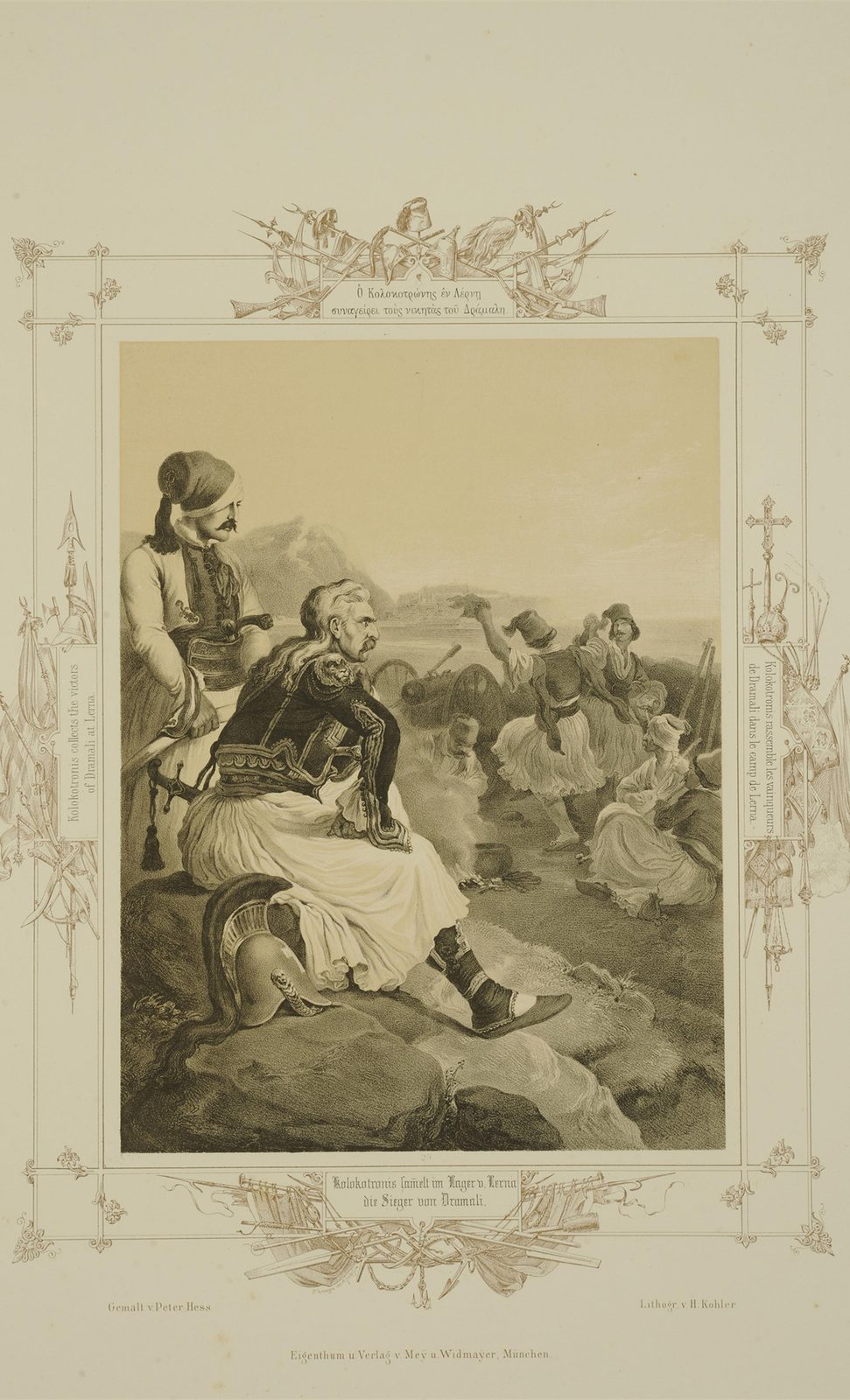
Kolokotronis makes the mills his headquarters
In the summer of 1822, as Dramali's army stood in the plain of Argos, Theodoros Kolokotronis made the mills of Lerna his headquarters. According to Samuel Howe he gathered up to 6,000 armed peasants there before the…
-
July 1822
The Greek senate takes refuge at Myli
When Dramali's Ottoman army poured into the Argolid in July 1822, the Greek senate fled to Myli. Dimitrios Ypsilantis fell back there with about 600 men, taking position between the sea and the foot of the steep…
-
24 November 1822
A police overseer for the Mills
During the War of Independence Myloi was a harbour and a supply point, so the revolutionary government gave it its own police official. Andreas Papadiamantopoulos was appointed "overseer of the police at Myloi". These…
-
31 May 1823
Harbour master and police chief of Myloi, 1823–1824
Spyros Stathopoulos became "general harbour master and police overseer of Myloi" and served until early 1824. After him came Konstantinos Michalopoulos ("Astynomos"), Panagis Orfanos as acting police chief (March 1824)…
-
March 1824 – June 1824
Myloi, seat of the Greek government
For more than two months in the spring of 1824, the Executive of Georgios Kountouriotis governed from Myloi and the ships off its shore. Proclamations and letters of the time are signed 'from Myloi of Nafplio'; the…
-
17 May 1824
Mourning salutes for Byron off Myloi
A report sent 'from Myloi of Nafplio' tells that the memorial service for Lord Byron, who had died at Missolonghi, was held that day in Argos. The flagship lying off Myloi fired mourning salutes.
-
22 May 1824
Kolettis writes a letter from Myloi
Ioannis Kolettis, member of the Executive, dated a letter 'From Myloi of Nafplio, 10 May 1824'. It was printed half a century later in an Athens newspaper. A French version of a proclamation from the same days carries…
-
June 1825
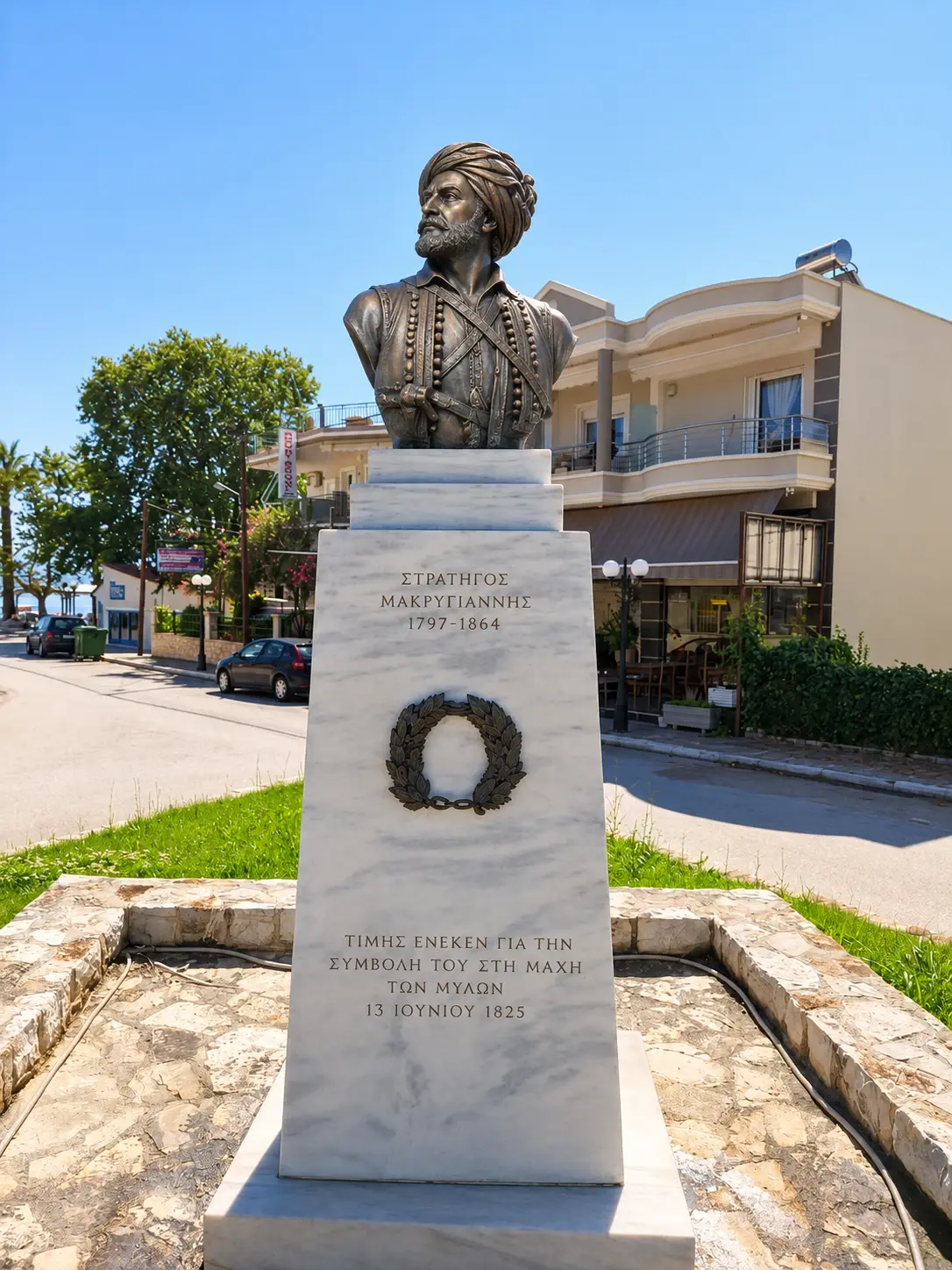
Makriyannis fortifies the mills
Makriyannis and the war minister Andreas Metaxas chose to stop Ibrahim at Myloi, then a hamlet of about thirty houses. Makriyannis built ramparts, cut loopholes in the garden wall and strengthened the old stone tower.…
-
25 June 1825
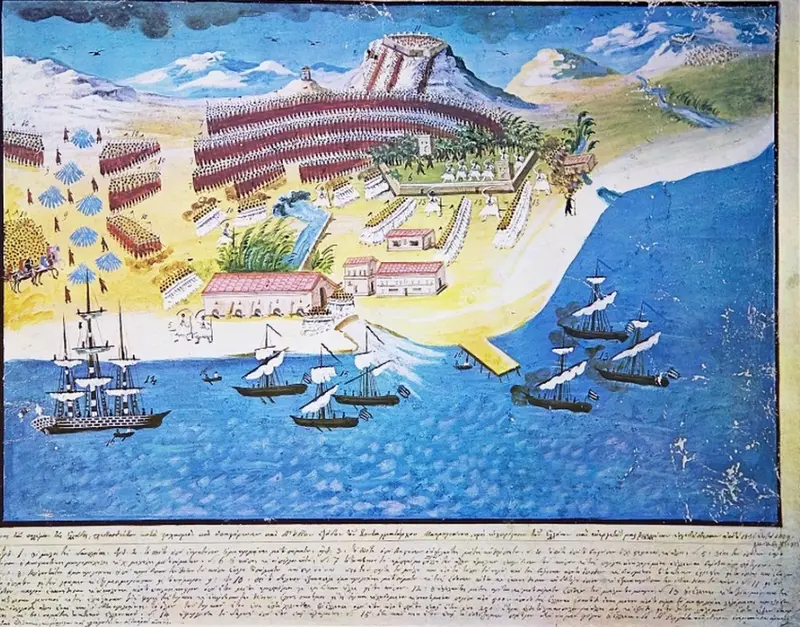
The Battle of Myloi
Ibrahim Pasha's army attacked the fortified mills in the late afternoon, in three columns along the Argos road, over the hill and from the Kiveri side. A few hundred Greeks under Dimitrios Ypsilantis, Makriyannis and…
-
3 October 1827
Medicine against fever requested at Myloi
Captain Konstantis Veris, who held Myloi with his soldiers, asked Ioannis Kolettis to send medicine against 'the fever'. The marshes of Lerna made malaria a constant danger for anyone stationed at the mills.
-
1829
1829: 61 families, 181 people
The French scientific expedition to the Morea counted "Myli" in the province of Argos at 61 families and 181 people. The expedition noted that the war had sharply reduced the population of the area, but that it was now…
-
30 May 1831
American sailors find 'a little collection of huts'
Officers of the American frigate USS Constellation visited Lerna. Enoch Wines wrote that the water from the spring was led away in a canal and turned a few mills, which gave the name Mylos to a little group of huts built…
-
July 1832
Fighting at Myli after the murder of Kapodistrias
In the chaotic months after Governor Kapodistrias was murdered, rival Greek factions clashed at Myli. The archaeologist Ludwig Ross, newly arrived in Nafplio, wrote that General Krieziotis and his Roumeliot troops had…
-
19 June 1834
Myloi becomes seat of the municipality of Temenion
When King Otto's government divided Greece into municipalities, Myloi became the seat of the municipality of Temenion (Δήμος Τημενίου), named after the ancient harbour town nearby.
-
4 November 1840
A town hall in Myloi
A notice in the Athens paper Athina announces an auction "in Myloi of the municipality of Temenion, in front of the town hall". A year later a court paper mentions "the café in Myloi of the municipality of Temenion". So…
-
30 December 1840
The municipality of Temenion disappears
According to the official register of administrative changes, Temenion was merged into the municipality of Argos in December 1840. Yet newspapers still speak of "the municipality of Temenion" in 1841 and 1845. By 1864 at…
-
1843
Myloi chooses an elector
For the elections to the National Assembly after the revolution of 3 September 1843, each village chose electors. For Myloi this was Panagis Spanos, the earliest villager of Myloi we know by name in a public role.
-
1843
A state salt depot at Myloi
Salt was a state monopoly, and Myloi had a state salt depot (alatapothiki) from at least 1843. Its keepers were civil servants, and appointments and dismissals appear in the newspapers until at least 1877.
-
March 1858
The village councillor welcomes King Otto and Queen Amalia
King Otto and Queen Amalia came by steamer from Nafplio to Myloi, where all the villagers met them with local music. The special councillor (ειδικός πάρεδρος) of Myloi, "Mr Loukas", had strewn the streets with myrtle and…
-
17 February 1862
Telegrams from Myloi about the revolt in Nafplio
When the garrison of Nafplio rose against King Otto in February 1862, some of the first news reached Athens through messages sent from Myloi by the keeper of the state salt depot. They were printed in the press dated…
-
1864
The first known priest and teacher of Myloi
A report of 1864 mentions a priest who had served the villages of Myloi and Skafidaki until the feast of Saint George that year, and who had earlier been the teacher of the same villages. So Myloi already had some form…
-
April 1864 – May 1864
Robbers carry off the village councillor
At nightfall a band of more than twelve robbers raided "the village of Myloi of the municipality of Argos". They robbed the councillor (πάρεδρος) Loukas Giannakopoulos and led him bound as far as the bridge of the…
-
1869
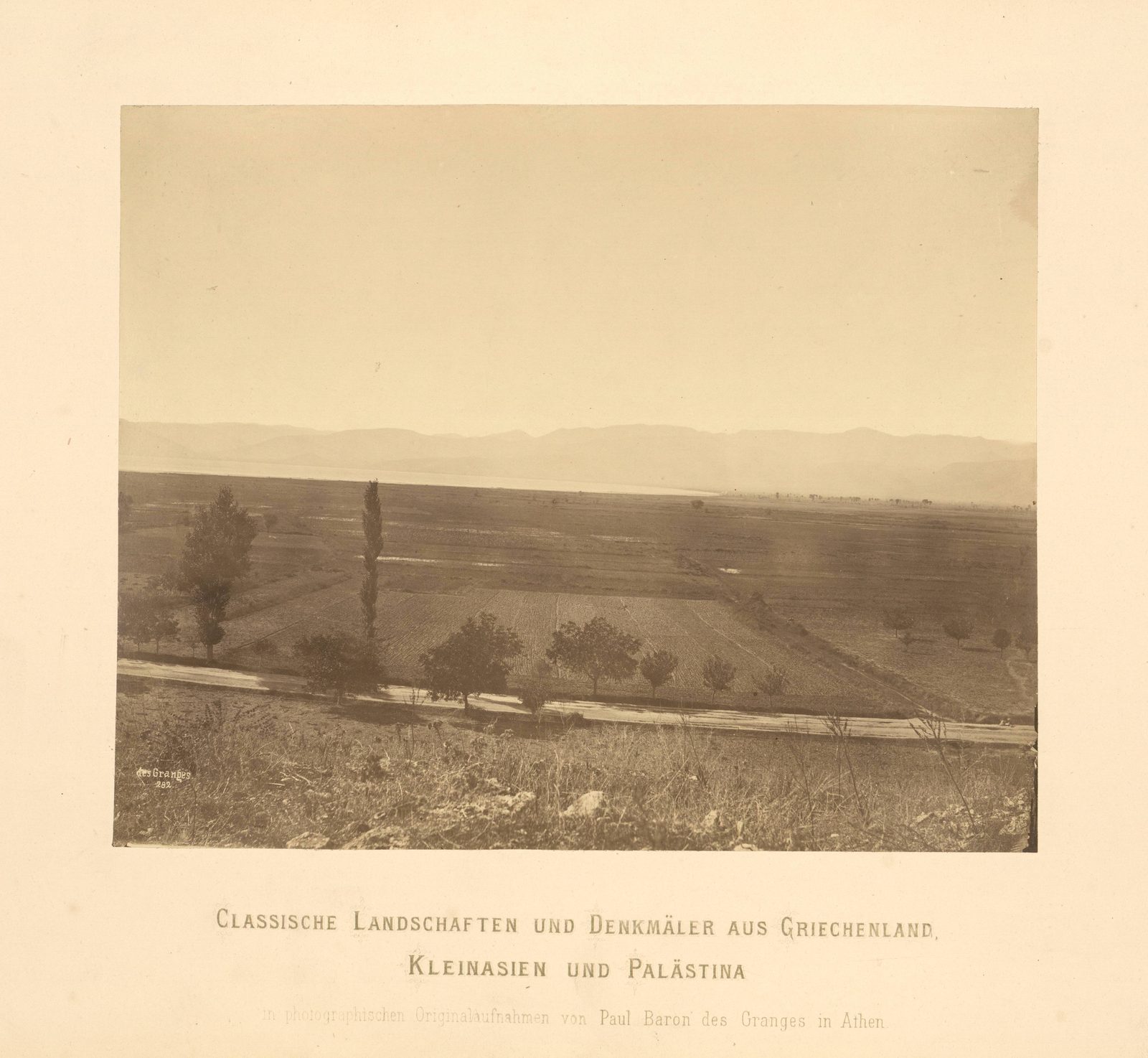
An early photograph across the plain to Lerna
Baron Paul des Granges photographed the gulf of Argos from Tiryns 'in the area of the Lernaean marsh'. On the horizon the west coast of the gulf with Lerna and Myloi can be made out below the mountains. It is one of the…
-
1873
Myloi gets a customs station
After years of requests, a law of 1873 set up 'a customs station at Myloi of Argos'. Goods for Arcadia no longer had to make the detour through Nafplio. In 1874 a newspaper noted that there were public offices at Myloi.
-
19 October 1878
Prices set for the state land around Myloi
Much of the land around Myloi was still 'national land', former Ottoman property that had passed to the Greek state. Under the law for distributing it to farmers, the cabinet set its price per stremma at Myloi: 60 to 100…
-
1879
1879: 135 inhabitants, part of the municipality of Argos
The census of 1879 counts 135 people in Myloi: 78 men and 57 women. The village then belonged to the municipality of Argos (Δήμος Αργείων), together with Kiveri and Skafidaki. The surplus of men fits a village of…
-
3 August 1881
A telegraph office for Myloi is requested
Newspapers in Tripoli and Athens supported a request for a telegraph station at Myloi, the busy landing place on the road to Arcadia.
-
1882
A branch line to Myloi in the first railway contract
In 1882 the government of Charilaos Trikoupis signed the contract for the Peloponnese railway. Besides the main line it included two branches: Corinth–Argos–Nafplio and Argos–Myloi.
-
1883
Baedeker: the 'Skala' with the most important mill
The German Baedeker guide of 1883 described Myli as a village stretching along the road at the foot of Pontinos. Below the road, near the chapel of Agios Ioannis, a mighty spring broke out. Part of the village, the…
-
3 September 1883
A state grant for the school of Myloi
A royal decree on grants to municipalities for primary education gave Myloi, in the municipality of Argos, 10 drachmas a month 'for the grammar school' (grammatoscholeio), a small school where children learned to read…
-
1884
A locomotive called ΜΥΛΟΙ
In 1884 Krauss in Munich built five small tank engines for the Peloponnese railway. Each got a name, and one of them was called ΜΥΛΟΙ. Engines of this series later worked the short branch Nafplio–Argos–Myloi.
-
11 January 1886
The schoolmaster of Myloi is paid by the state
A new decree on school grants again gave Myloi 10 drachmas a month, now 'for the schoolmaster' (grammatodidaskalos). Together with earlier reports, it shows that the village kept a small school of its own in the years…
-
31 July 1886
A French engineer plans a line from Myloi to Kalamata
Even before the train reached Myloi, the French chief engineer Gotteland handed the ministry a study for a railway from Myloi via Tripoli to Kalamata. The line would be 185 km long and cost 21 million drachmas.
-
April 1887
Trikoupis proposes a line from Myloi into the mountains
In April 1887 Prime Minister Charilaos Trikoupis proposed building a railway from Myloi via Tripoli to Kalamata at state expense. Myloi was chosen as the starting point because it lay at the end of the existing line,…
-
October 1887
Smuggled silks found on the shore of Myloi
In the autumn of 1887 the justice of the peace and the gendarmerie of Argos heard that goods were being smuggled ashore at Myloi. They went to the beach and seized six large crates and a parcel of silk fabrics, neckties…
-
2 December 1887
Parliament gets the bill: 'The line leaves from Myloi'
Minister Lomvardos sent parliament a bill to build a metre-gauge line 'from Myloi of Nafplia via Tripoli to Kalamata' at state expense. The attached survey said the line would leave Myloi, climb along the stream valley…
-
15 April 1888
Myloi gets its own post office
A 'Post Office of Myloi' was set up in the village. The mail for Tripoli now came by train as far as Myloi, and the paper expected Myloi to become the centre of 'numerous engineers, contractors and workers' once building…
-
26 January 1889
A Spanish steamer brings the first building materials
On a Saturday in January 1889 a Spanish steamer sailed into Myloi with materials for the new Myloi–Kalamata railway. The works began at both ends of the line, Myloi and Kalamata, because materials could arrive there by…
-
23 March 1889
Ten extra gendarmes for Myloi
At the request of the mayor of Argos, the gendarmerie of Argolis reinforced its post at Myloi with ten men. With hundreds of railway workers arriving, the paper called it 'an excellent measure for public order'.
-
24 March 1889
Workers of every nation, and 'famous cutlets'
'Workers of various nationalities pour in there every day,' wrote a correspondent about the building site of the Myloi–Kalamata line. A good restaurant had been built: 'In Myloi-Lerna you can taste famous cutlets.' He…
-
17 June 1889
Railway workers without work and in debt
The big contractors kept re-letting sections to small sub-contractors, and workers offered themselves for 80 lepta a day. Many sat without work and without a penny, in debt to every shop on the site. Grocers and…
-
30 July 1889
Boomtown Myloi: holidays, wine and brawls
'It is a fine sight,' wrote the Nafplio paper: from Myloi to Tripoli crowds of workers of every nationality and language, and carts bringing rails and sleepers. But on holidays and days off this whole crowd gathered in…
-
19 September 1889
Myloi has a customs post
Under a new customs law, Nikolaos Theologidis was formally appointed head of the customs post at 'Myloi of Argos', a job he already held. Goods landed at Myloi had to pass through his hands.
-
6 November 1889
1,945 workers, men and women, on the section from Myloi
A report to the minister counted 96 engineers and overseers, 106 assistants and guards, and 1,945 navvies, miners and labourers, 'men and women', on the section starting at Myloi. Seven kilometres of track had been laid,…
-
14 December 1889
A new head of customs: Nikitas Loudaros
Nikitas Loudaros was appointed head of the customs post of Myloi. He replaced Nikolaos Theologidis, who had held the post for more than two years and was promoted to deputy customs officer on Othonoi.
-
26 December 1889
Rolin takes on a second line
A new contract gave Ernest Rolin, contractor of the Myloi–Kalamata line, the branch Karytaina–Megalopoli–Leontari as well. His agent Louis Rosseels had to found a Greek company within 30 months, and the rolling stock of…
-
7 April 1890
A locomotive already runs from Myloi to kilometre 12
The correspondent in Myloi reported that a locomotive was already running from Myloi to kilometre 12.2. The great bridge of Lerna was still not finished because of the difficult ground; the opening as far as…
-
June 1890
The mail coach from Myloi to Tripoli plunges into a ravine
Before the trains ran to Tripoli, passengers and mail went on by road from the station at Myloi. In June 1890 the mail coach from Myloi to Tripoli fell into a ravine near the bridge of Achladokampos; four people died.
-
1891
MPs want to inspect the works for abuses
A group of MPs proposed sending a parliamentary committee to inspect the works on the Myloi–Kalamata line and to investigate abuses reported by the engineer and MP N. Schinas, including whether the carriages were fit for…
-
13 January 1891
The Belgian engineer Couzin goes home; Rolin takes charge
Victor Couzin, who had directed the works on the Myloi–Kalamata line for two years for the firm Couzin–Génis, had gone back to Belgium with his wife. The original contractor, Ernest Rolin, now took over the direction of…
-
13 February 1891
Myloi–Tripoli almost ready: only an iron bridge to go
Answering a question in parliament, the government said that the section from Myloi towards Tripoli had been built and was 'almost completely finished'; only the assembly of one iron bridge remained.
-
6 July 1891
Soldiers along the line, because of stolen materials
On the opening day soldiers of the engineers stood at intervals along the line to prevent any attack on the railway by some local people. According to the paper, materials worth about 200,000 drachmas had been stolen…
-
8 July 1891
Opened, but no trains yet
Two days after the opening the paper Akropolis wrote that services would not start at once, probably in about 15 days, because the staff was not yet complete. On the opening day an agreement had been signed handing the…
-
10 July 1891
Newspapers abroad report the opening
A telegram from Athens of 7 July appeared in the Lodzer Tageblatt in Poland: the section Myli–Tripolis of the Myli–Kalamata railway had been opened 'yesterday in the presence of the King, the ministers and numerous…
-
September 1891 – October 1891
Works halted: hundreds of unpaid, hungry workers
In the autumn of 1891 the works on the line beyond Tripoli came to a halt. Hundreds of workers, most of them Italians and some French, were owed their daily wages; the papers spoke of 900 to 2,000 men, and of workers…
-
6 November 1891
The state pays to feed the railway workers
The government opened a credit of 5,000 drachmas 'for the care and feeding of the workers of the Myloi–Kalamata railway'. Most of the stranded men were found work on the Corinth Canal and on the line to Larissa.
-
22 November 1891
Foreign powers protest about the unpaid railway workers
The Belgian company building the Myloi–Kalamata railway had collapsed and its foreign workers had lost their wages. On a Sunday in November 1891 the envoys of several powers handed the Greek government a joint note…
-
1892
Italian workers and suppliers register their claims
In 1892 the Italian legation in Athens called on Italian 'piece-workers, labourers and food suppliers of the Myli–Calamata line' to register what they were still owed. An Athens paper wrote that Rolin's bankrupt company…
-
27 January 1892
A law gives the line from Myloi to the Peloponnese railway
A law confirmed the December contract and obliged the ΣΠΑΠ to open the whole line Myloi–Kalamata to the public within one year.
-
27 February 1892
The train from Myloi stops before a damaged bridge
The train from Myloi stopped in front of the damaged bridge of Maskena: the driver did not dare to cross. The 'much-plagued' line had a difficult start.
-
22 September 1892
A change at the customs post
The official gazette recorded that Andreas Papandreou was appointed head of the customs post of Myloi in place of Georgios D. Mousmoulis, who was dismissed. Nikitas Loudaros, an earlier head of the post, was moved to…
-
7 August 1897
Another new head for the customs post
I. P. Digenis, formerly head of the customs post of Kionion, was appointed head of the customs post of Myloi. The heads changed often: in 1894 his predecessor (the name is unclear in the scan) had been promoted…
-
November 1899
The line from Myloi finally reaches Kalamata
After Tripoli–Kourtaga (1897) and Kourtaga–Fragkoi (1898), the last gap to Diavolitsi was closed in 1899. According to the railway society ΣΦΣ the ΣΠΑΠ put the whole line from Myloi to Kalamata into service in November…
-
4 April 1900
'Silting made the pier useless': the extension is dropped
Introducing the bill, Prime Minister Theotokis told parliament that the bottom of the bay and the silting at Myloi made a longer pier useless. He added that the place was so unhealthy that, although the railway had come…
-
1906
Andes Candies: a founder from Myloi or from Achladokampos?
In 1934 the New York Greek daily Ethnikos Kiryx wrote that Andreas G. Kanelos (Kanellopoulos), founder of the Andes Candies shops in Chicago, "comes from Myloi of Argos" and arrived in America in 1906 at the age of…
-
1909–1914
Young men from "Myli" and "Mylous" on the Ellis Island lists
A search of about 10,300 Ellis Island records found some twenty Greek travellers who gave Myli, Mylous or Milon as home, most between 1909 and 1914. They were mostly single men of 17 to 27, sailing from Patras or Piraeus…
-
January 1911
Paraschos Pagkas, the village schoolmaster
Two newspapers of January 1911 call Paraschos Pagkas "the learned schoolmaster of Myloi". He is the first teacher known by name who certainly taught in the village.
-
24 April 1911
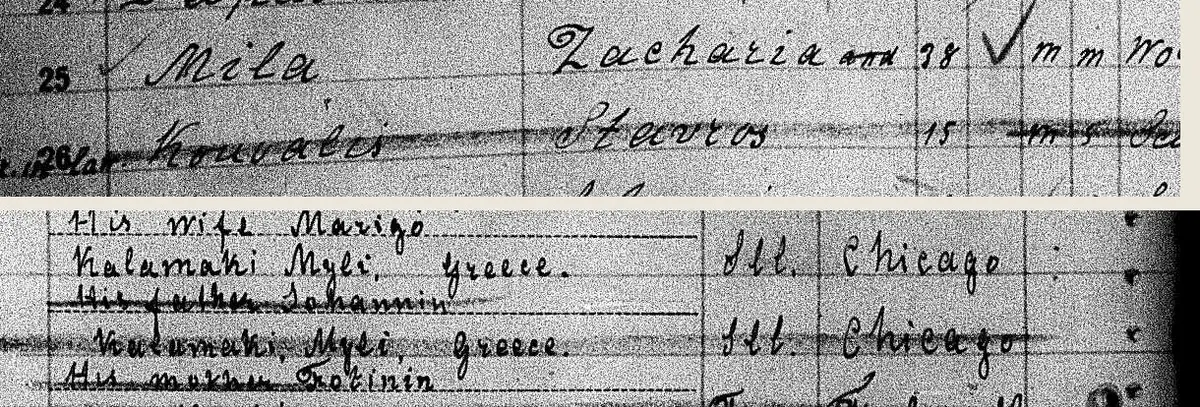
On the Patris to Chicago: Mila and Stavros Kouvalis
Zacharia Mila (38) and fifteen-year-old Stavros Kouvalis sailed from Piraeus on 4 April 1911 on the Patris, the first Greek liner to New York, and arrived twenty days later. Both were going to Angelos Kouvalis, Stavros's…
-
5 June 1912
A court case against the mill family
On 23 May 1912 (old style) the court of first instance in Nafplio (judgment 539/1912) ordered the heirs of Georgios Vasilopoulos, who had died in 1907, to pay a debt of 2,483.75 drachmas to a creditor from Argos. Most of…
-
9 July 1912
The first trace of an emigrant in Canada
A judgment of the Athens court of first instance names, among the debtors of an ice company, a resident of Myloi "living in Canada". It is the earliest known link between Myloi and Canada, more than fifty years before…
-
31 August 1912
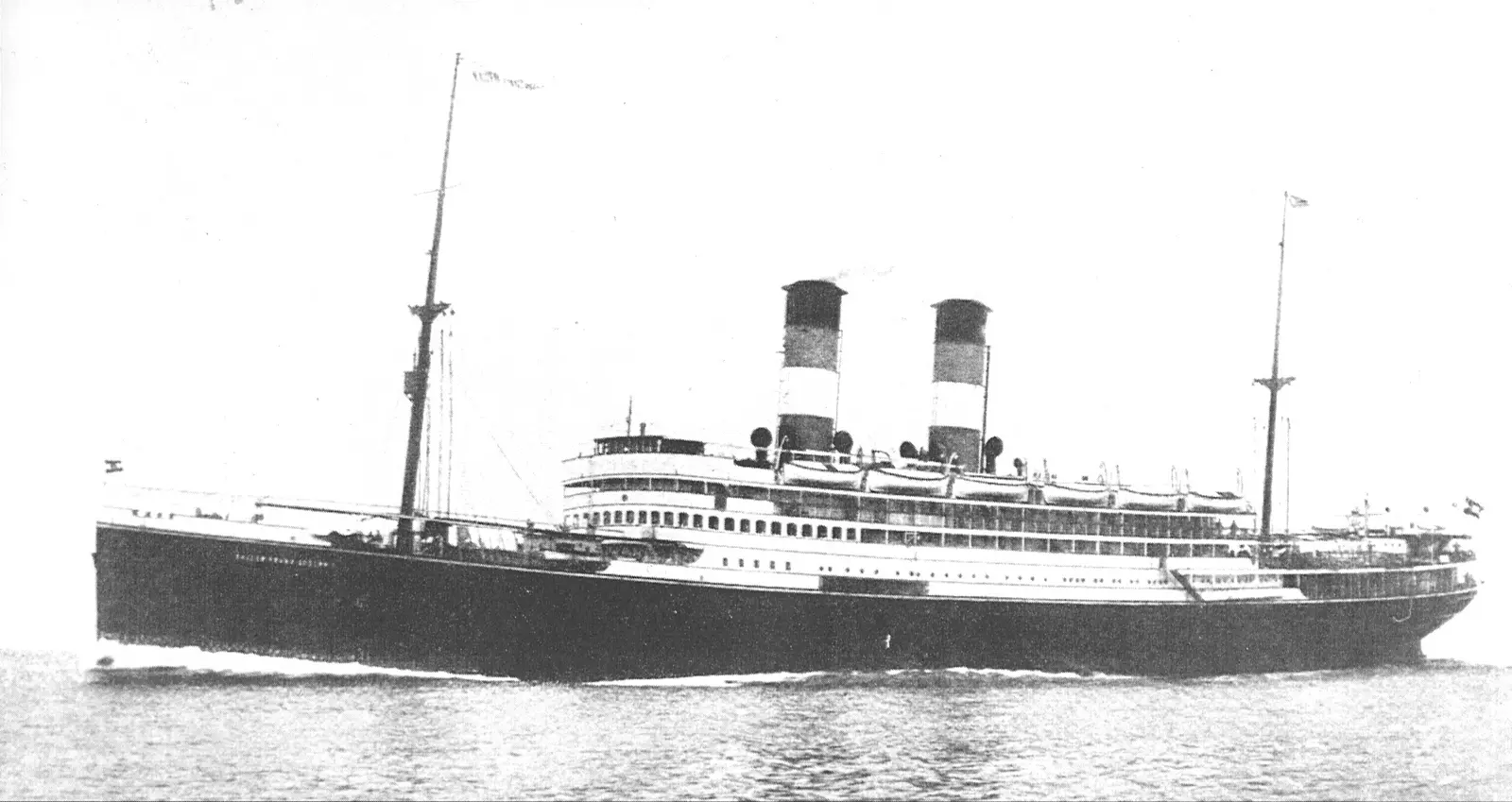
Zachos Antoniou goes to the mills of Lowell
Zachos Antoniou from Myloi, a 23-year-old farmer and son of Costas, left Patras on 19 August 1912 in steerage on the brand-new Kaiser Franz Josef I and reached New York twelve days later. He was going to a cousin in…
-
13 September 1912
Myloi becomes part of the community of Kiveri
With the reform that replaced the old municipalities by village communities, Myloi was separated from Argos and placed in the new community of Kiveri.
-
16 June 1914
Zachos Antoniou again, now to his brother in Eureka
By 1914 Zachos Antoniou was back in Myloi, perhaps because of the Balkan Wars. On 26 May 1914 he left Patras again on the Pannonia and arrived in New York on 16 June, heading for his brother George Antoniou in Eureka,…
-
1922–1961
A quiet line from Myloi to Chicago
Apart from Mila and the Kouvalis brothers, other threads lead from Myloi to Chicago. In 1922 a man in Chicago sent greetings in a New York Greek paper on the wedding of a bride "from Myloi of Argos", and in 1961 the…
-
13 January 1927
'Skala': Myloi as the landing place of Tripoli
An Athens paper described Myloi as a village on the railway to Tripoli, 'well-watered, full of trees and pleasant', with tall eucalyptus trees along the beach where the boats lay. Besides its name from the many water…
-
March 1927 – April 1927
The priest of Myloi dies, and America hears of it
A letter "from Argos, 3 April 1927", written for the people of Argos in America, reports the sudden death of the priest Christos Nikolaou Giannakopoulos "from the village of Myloi of Lerna". All the people of Myloi,…
-
17 April 1927
A café-restaurant by the sea
An advertisement announces the "café-restaurant of Stylianos Balaskas in Myloi", opened by the sea in the premises that used to belong to Georgios Koutouzos, promising "care, cleanliness, low prices".
-
1 October 1928
Myloi gets its own community
Myloi left the community of Kiveri and became the seat of its own community, the Κοινότης Μύλων, with an elected president and council. This community lasted until the Kapodistrias reform of the late 1990s.
-
2 October 1928
A tobacco smuggler caught at Myloi
The commander of the police post of Myloi, Ch. Gkekopoulos, arrested a smuggler from Dalamanara who was carrying a sack of cut tobacco and cigarette paper.
-
1929–1938
Weddings across the mountains
The Kynouria papers announce at least four engagements between men from Myloi and women from Vervena and nearby Xiropigado in 1929, 1931 and 1938. They are the human side of the yearly winter migration from the mountains…
-
14 November 1929
Winter quarters for the shepherds of Vervena
Every autumn the people of Vervena, a mountain village in Kynouria at about 1,200 metres, left home for warmer winter villages with their flocks. A correspondent from Vervena lists them in 1929: among them Kiveri, Myloi,…
-
December 1930
The customs post is still open: a new chief in 1930
The Argos paper reported that 'a few days ago the new head of the customs post, Grigorios Dymoperis, took up his post in Myloi'. Customs officers had been stationed in Myloi for at least forty years.
-
August 1937
An honest track gang returns a lost sack of silk cocoons
The director-general of the ΣΠΑΠ publicly praised the track gang of the Myloi–Kalamata line, a foreman and four workers, who had found a sack of silk cocoons fallen from a train, worth 2,500 drachmas, and handed it in.
-
7 August 1939 – 12 August 1939
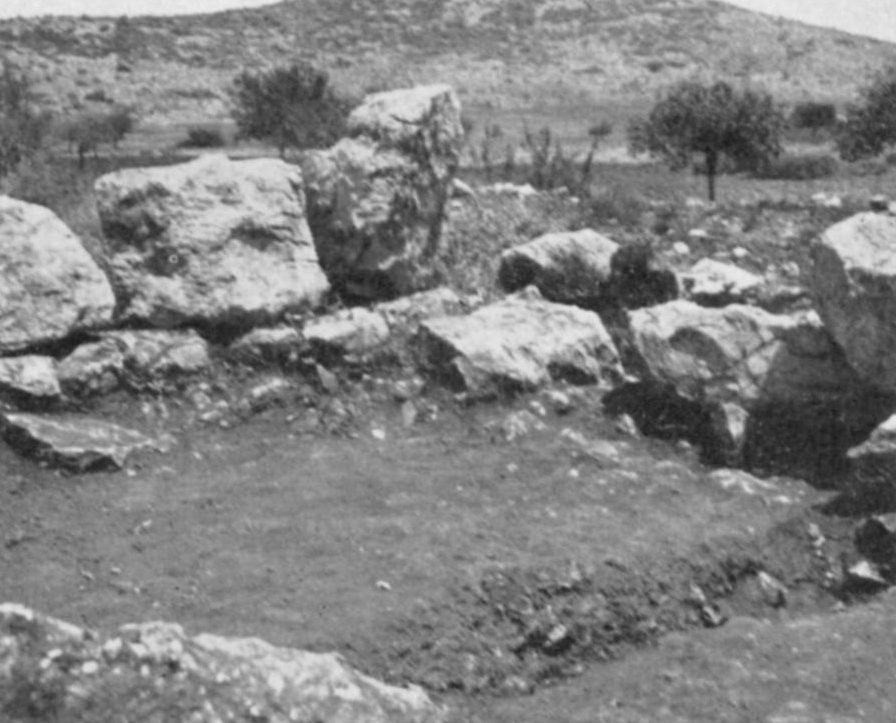
Americans excavate the blockhouse near Myloi
From 7 to 12 August 1939 Louis E. Lord, Alison Frantz and Carl Roebuck of the American School excavated an ancient blockhouse three kilometres beyond the spring of Lerna, beside the road to Tripoli. The finds were given…
-
26 September 1939
The dictatorship replaces the village council
Under the Metaxas regime a royal decree dissolved the councils of Skotini, Kiveri and Myloi because they were "hindering normal operation". For Myloi an appointed committee took over: Nikolaos Chr. Giannakopoulos as…
-
16 October 1940
Census 1940: Myloi 388, Kalamaki 50
Shortly before Greece entered the war, the census counts 438 people in the community of Myloi: 388 in the village and 50 in Kalamaki (29 men and 21 women). Since 1879 the village had almost tripled in size.
-
16 October 1940
Kalamaki becomes an official settlement of Myloi
In the census of 16 October 1940 Kalamaki (officially Καλαμάκιον) is listed for the first time as a separate settlement and attached to the community of Myloi. The name itself is older: emigrants of 1911 gave…
-
28 December 1940
A soldier born in Myloi dies in the military hospital of Mesolongi
Private Panagiotis Lymperopoulos, son of Epameinondas, born in Myloi in 1915, died in the military hospital of Mesolongi on 28 December 1940, during the Greek-Italian war. He is listed in the Greek Army's roll of the…
-
1941–1942
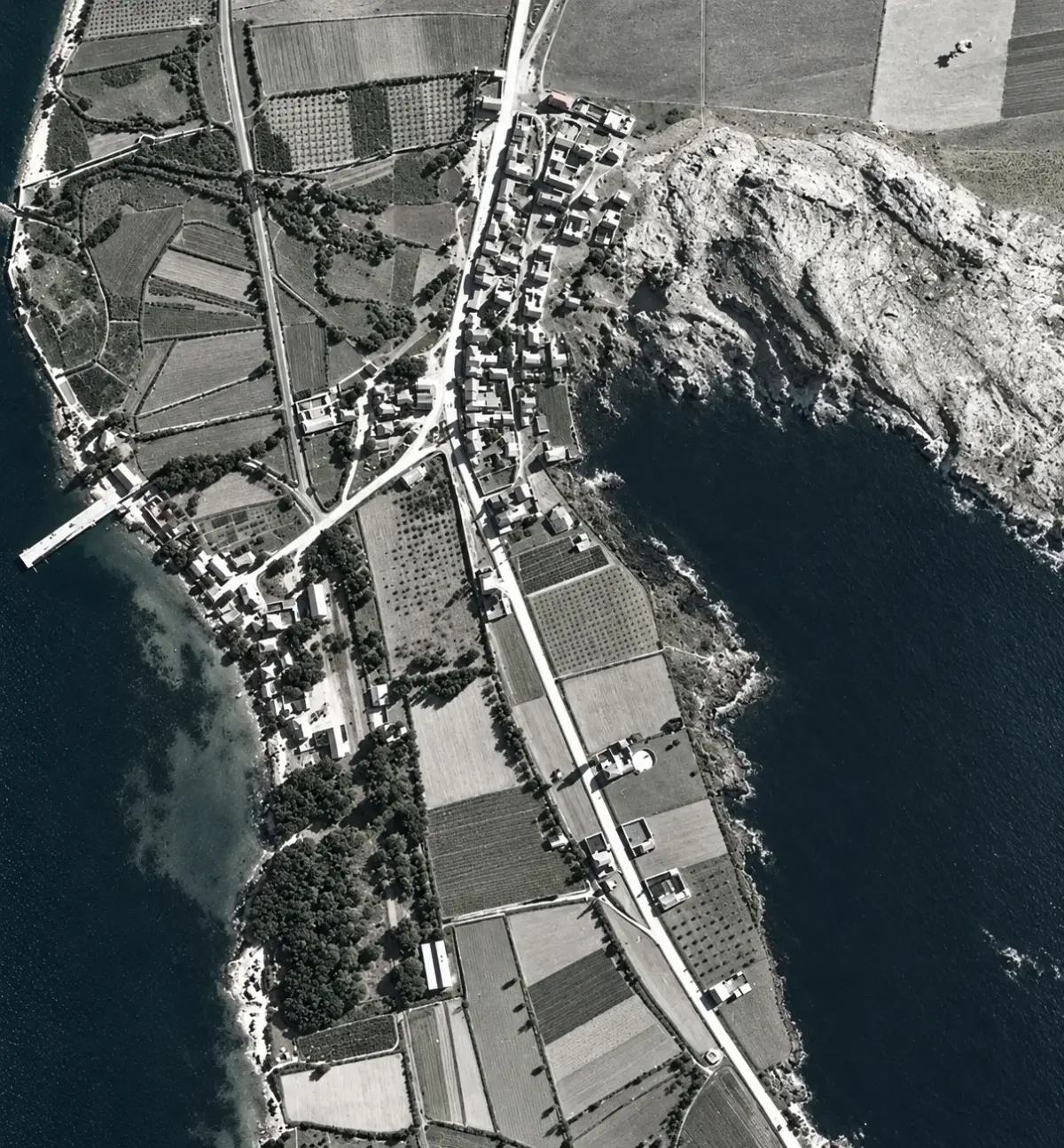
A second German reconnaissance flight photographs the bay
A German strip flight of 1941–1942 (film 93) photographed Myloi again: the curve of the bay, the village along the main road at the foot of Pontinos, the station and the pier.
-
1941–1943
A coastal gun near the tower of Bouboulina
Among the occupation defences of Myloi was a coastal gun next to the tower known as the tower of Bouboulina. The base of the gun emplacement could still be seen in 1994.
-
1941–1943
Men rounded up in Argos work on the Myloi fortifications
The occupation authorities set up roadblocks in Argos, seized the men they found and took them away in a lorry that the people of Argos nicknamed 'Bogia', the dog-catcher. Most of this forced labour went to the airfield,…
-
1941–1943
The Italian garrison fortifies the coast: anti-tank ditch and barbed wire
Myloi had its own Italian garrison. The Italians took over the fortification of the village against an Allied landing: they dug an anti-tank ditch, laid barbed wire and set up an anti-aircraft unit and gun batteries…
-
1941–1943
Myloi in the Italian zone of occupation
From the summer of 1941 until September 1943 Myloi lay in the Italian zone of occupation, which covered most of the Peloponnese; Italian troops of the 'Siena' division held Argos and Nafplio from May to September 1941.…
-
23 April 1941
King George II leaves Greece from Athens, not from Myloi
On 23 April 1941 King George II, members of his government and the British Minister flew by Sunderland flying boat from Skaramangas near Athens to Souda Bay on Crete. A later reader's letter claimed that the king left…
-
24 April 1941
A flying boat waits in the bay for General Mackay
Just before dusk on 24 April 1941 a Sunderland of No. 228 Squadron RAF, flown by Flight Lieutenant Alex Frame, came down in the Gulf of Nafplio to collect RAF men. They had already gone, so it took on board about 25…
-
24 April 1941
Advanced headquarters of W Force moves to Myloi
On 24 April 1941, with the evacuation of Greece under way, the Advanced Battle Headquarters of W Force, the British and Commonwealth army in Greece, settled in at Myloi. The village lay on the road from the plain of…
-
25 April 1941
Australian 2/2nd Battalion lies up at Myloi during the day
The war diary of the Australian 2/2nd Infantry Battalion records: arrived Myloi at 06:00 on 25 April 1941, lying up during the day, and left at 20:00 for Kalamata via Tripoli. On 26 April the men were embarked at…
-
25 April 1941
The Allen Group, 6,000 men and 600 vehicles, hides around Myloi
At daylight on 25 April 1941 the Allen Group arrived at Myloi after a night drive from Eleusis: about 6,000 men and 600 vehicles of the 16th and 17th Australian Brigades under Brigadier A. S. Allen. The vehicles were…
-
25 April 1941
The Australian column leaves Myloi at 8 p.m.
Orders came in the afternoon of 25 April 1941. At 20:00 the Allen Group set off from Myloi over the mountain road to Tripoli and on to Kalamata, where the troops were to be taken off by the Navy. Australian military…
-
25 April 1941
General Freyberg moves to a new headquarters near Myloi
Early on 25 April 1941 Major-General Bernard Freyberg, commander of the New Zealand Division, was on his way to 'a new headquarters near Miloi'. In the next days Myloi was described as the headquarters of both W Force…
-
25 April 1941
General Mackay leaves by flying boat at dawn
Early on 25 April 1941 Major-General Iven Mackay, commander of the 6th Australian Division, flew to Crete in a Sunderland; the New Zealand official history says he left 'from Miloi'. At dawn the bay was full of smoke…
-
25 April 1941
An Australian medical unit waits in an olive grove west of the bay
The Australian official medical history tells of a medical unit that moved with the 17th Brigade by Corinth and Argos 'to an olive grove west of Miloi Bay', and from there by Tripoli to Kalamata. The men left their…
-
25 April 1941 – 26 April 1941
General Wilson drives from Athens to Myloi through the night
General Henry Maitland Wilson, commander of all British and Commonwealth forces in Greece, moved his headquarters south of Argos in the night of 25 to 26 April 1941. His party crossed the bridge over the Corinth Canal…
-
26 April 1941
New Zealand 25th Battalion guards the approaches to Myloi
In Freyberg's new arrangement of 26 April 1941 one New Zealand battalion went north of Argos and one to Tripoli, while the 25th Battalion stayed in reserve at Myloi. Its companies took position between the village and…
-
26 April 1941
Dive bombers hit the 24th Battalion camp: four New Zealanders killed
The New Zealand 24th Battalion reached Myloi early on 26 April 1941 and rested in a dried-up riverbed. Australian lorries driving to the camp in daylight were spotted, and dive bombers attacked the area at intervals for…
-
26 April 1941
Wilson's headquarters in an olive grove at the Tripoli road
On 26 April 1941 the headquarters of W Force was hidden in an olive grove at Myloi, where the trees gave cover from the German dive bombers. Wilson himself wrote that it lay 'close to where the road to Tripolis leaves…
-
27 April 1941
Shortly after midnight the New Zealand rearguard passes Myloi
Shortly after midnight on 27 April 1941 the rear party of the New Zealand Division, the 6th Brigade, passed Myloi going south towards Tripoli. After that there was nothing between the flying boat in the bay and the…
-
28 April 1941
German advance guard enters Myloi at 6.10 p.m.
On 28 April 1941 the 5th Panzer Division, with two companies of paratroopers, pursued the British through Argos towards Tripoli and Kalamata. According to messages from the Luftwaffe, its advance guard entered Myloi at…
-
20 May 1941
The telephone cable from Myloi to the Argos airfield is cut
In May 1941 a German telephone line ran from Myloi along the railway, under the Xerias bridge and past the Aspida to the airfield of Argos; it served the airfield's anti-aircraft defence. A small group of young men from…
-
13 July 1941
A German survey aircraft photographs Myloi from the air
On the morning of 13 July 1941 an aerial survey unit of the German air ministry flew over Myloi at about a thousand metres with camera no. 741 pointing straight down. The photographs, a strip from north to south along…
-
October 1944
The Security Battalions of Tripoli are disarmed at Myloi and shipped to Spetses
Under an agreement made at the end of September 1944, the collaborationist Security Battalions of Tripoli under Dionysios Papadongonas marched in formation, with their personal weapons, to Myloi. There they handed their…
-
11 January 1945
Truce terms: ELAS must withdraw 'beyond Myloi'
The truce of 11 January 1945 between EAM, the British forces and the government required the ELAS fighters to leave Argos and withdraw 'beyond Myloi'. British troops entered Argos on 19 January 1945. Witnesses remembered…
-
26 January 1947
Two armed men with landmines appear in Myloi
In the night of 26 to 27 January 1947 two armed men carrying two landmines appeared in Myloi, the newspaper Rizospastis reported. No casualties were mentioned. The mines were probably meant for the railway, which became…
-
June 1948
A rural militia unit is ambushed in the Myloi area
The army communiqué printed in Eleftheria on 9 June 1948 reported that a group of the MAY, the rural security militia, fell into an ambush of the Democratic Army in the area of Myloi. Nine militiamen were killed and four…
-
June 1948
Partisans blow up a railway bridge between Myloi and Tripoli
The army communiqué of 19 June 1948 reported that partisans of the Democratic Army had blown up a railway bridge on the line between Myloi and Tripoli. In the fighting one government soldier and nine partisans were…
-
November 1948
The Corinth–Tripoli passenger train hits a mine near Myloi
In November 1948 the passenger train from Corinth to Tripoli struck a mine in the area of Myloi and was damaged. The army communiqué, printed on 25 November, reported no casualties.
-
14 December 1948
Operation 'Peristera': Myloi as a boundary point in the Peloponnese
In the army's plan for operation 'Peristera' against the Democratic Army in the Peloponnese (14 December 1948), the IX Division was to secure road and rail traffic in its zone and the works on the road…
-
29 April 1949
Myloi in the new prefecture of Argolida
The old prefecture of Argolida and Corinthia was split, and the community of Myloi, with Kalamaki, came under the new prefecture of Argolida.
-
1950s
A rural doctor for three years
Evangelos Koligliatis, born in Ira near Argos in 1922, served three years as rural doctor in Myloi in the 1950s, after two years in Filiates (Thesprotia). He later became a physician at the hospital of Argos.
-
1950s
A birth among the sheepfolds above Kalamaki
In an interview recorded in 1988, the old midwife of Kiveri remembered a birth "above Kalamaki, up at the sheepfolds". Afterwards the husband had to walk to the road and on to Myloi to call the doctor: there were…
-
7 April 1951
Census 1951: Kalamaki suddenly has 206 people
After the war and the civil war the community of Myloi has 639 inhabitants: 433 in Myloi and 206 in Kalamaki, four times as many as in 1940. The cause is not known; possibly families settled there temporarily, or the…
-
24 June 1953
Nikolaos Giannakopoulos, president of the community
On 24 June 1953 the president of the community, N. Giannakopoulos, signs a public tender "in Myloi". He had already led the village in 1939 as head of the appointed committee. In 1951 a newspaper lists him as a grocer.
-
1954
Forty people on the dig, the staff living in Myloi
In 1954 the team photographed itself: some forty people, archaeologists and workmen, many of them probably from the village. That season the staff lodged in Myloi, among them the field architect Lloyd Cotsen and the…
-
25 December 1954
Ilias Papoulias, president of the community
Ilias Papoulias signs as "president of the community of Myloi" a notice published on 1 January 1955. In 1959 he was a member of the council.
-
December 1955
A model cheese dairy in Myloi
The Argos paper Aspis praises "the energetic businessman in Myloi, Mr Chr. Koutouzos", who has founded a model cheese dairy, "an ornament of Myloi" and the only cheese-making centre of its kind.
-
1956
Loukas Kouvaras sets off round the world
Loukas Kouvaras, born in Myloi in 1931, studied mechanical engineering at the University of Houston. From 1956 to 1988 he worked for multinationals in Houston, New York, London, Brussels, Geneva, New Delhi, Bombay, Hong…
-
August 1956
A stone grave found at the entrance of the village
In August 1956 the Greek Archaeological Service, under E. Protonotariou, cleaned a stone cist grave found on a private plot at the entrance of Myloi from Argos. It was published in the Archaiologiki Ephimeris.
-
22 November 1956
Vervena still winters "as far as Myloi"
In 1956 a letter "from wintry Vervena" says that all its people have again settled in their winter quarters, "from Karakovouni, Meligou and Astros as far as Myloi of Argos and Skafidaki". The writer complains that the…
-
May 1957
Christos Papagiannis leads the village for ten years
From May 1957 Christos Papagiannis signs as president of the community of Myloi. He is still president in April 1967, a few days before the military coup of 21 April 1967. The community secretary in these years was…
-
13 October 1957 – 10 November 1957
A newspaper series on the first ice factory
Between 13 October and 10 November 1957 the Argos weekly Άσπις του Άργους printed four instalments of A. P. Tsakopoulos's "Historical notes: the first ice factory of Myloi–Lerna". Written partly from memory, it is the…
-
August 1958
Demosthenis Ntroulias, priest of Myloi
In August 1958 the Aspis of Argos names Demosthenis Ntroulias as the priest of Myloi. How long he served is not yet known.
-
30 June 1959
The village council makes John Caskey an honorary citizen
By unanimous decision no. 45 the council of Myloi declared the American archaeologist John Caskey an honorary citizen, for services to culture and to tourism in the community. It was signed by president Chr. Papagiannis…
-
31 July 1959
New York's Greek paper reports the honour
On 31 July 1959 the Greek-American daily Εθνικός Κήρυξ in New York reported, in its provincial news, that Caskey had been made an honorary citizen of Myloi. The news from the village thus reached emigrants in America.
-
19 March 1961
Census 1961: Myloi 503, Kalamaki 170
The census of 1961 counts 673 people in the community: 503 in Myloi and 170 in Kalamaki. Myloi passes 500 inhabitants for the first time.
-
1962
Headmistress Maria Pagkalou and the battle monument
In 1962 the Aspis of Argos praises the "progressive headmistress of the primary school of Myloi", Maria Pagkalou, for what she achieved within a few months together with the community committee. A later article says the…
-
14 November 1963
An Athens paper visits the president and his council
The evening paper Vradyni publishes a report on Myloi and its wishes: a longer harbour, the coastal road to Nafplio, a community office, a doctor's surgery and a museum. It names the council: Chr. Papagiannis…
-
20 June 1965
A lawyer from Myloi in Argos politics
In a series on "our new politicians", the paper Argolika Nea writes that Dionysios Styl. Balaskas "was born in Myloi of Argos". He studied law in Athens, fought as a gunner on the Albanian front, practised as a lawyer in…
-
1966
A man from Myloi meets Mitterrand in Paris
In 1966 Dimitrios Kotsonaros from Myloi, then 23, did his military service at a NATO office in Paris because he spoke French. Through friends he met the politician François Mitterrand, and they stayed friends for…
-
1967
Dimosthenis Ganas leaves for Winnipeg
Dimosthenis Ganas, born in Myloi in 1945, followed his brothers Nick and Ted to Canada at the age of 22. In Winnipeg, Manitoba, he became "Jim" and later joint owner of Nick's Inn, a roadside diner in Headingley.
-
1968
An aerial photo of Lerna and Myloi
Very probably in June 1968 the Jesuit photographer Raymond V. Schoder flew over the gulf and photographed Lerna and Myloi from the east: the shelter over the House of the Tiles, the village, the railway and the orchards.
-
27 January 1968
Under the junta: Georgios Granias
After the coup of April 1967 community presidents were appointed, not elected. In January and June 1968 Georgios Granias signs as president of the community of Myloi.
-
September 1968
Georgios Lermas, president 1968–1972
From September 1968 Georgios Lermas signs as president of the community of Myloi, and he still does so in July 1972. Like his predecessor he served under the military regime.
-
12 January 1970
An airman from Myloi dies on Mount Kithairon
A Dakota of the Greek air force, on a training drop of paratroopers from Elefsina, hit Mount Kithairon in bad weather near Villia; 23 men died. Among them was flight sergeant Ilias Psomadakis "from Myloi of Argolida",…
-
14 March 1971
Census 1971: Kougeika appears
In 1971 the community of Myloi has 675 inhabitants: 466 in Myloi, 171 in Kalamaki and 38 in Kougeika, which is recognised as a settlement in this census. Myloi itself shrank a little, as many Greek villages did in these…
-
April 1973 – November 1973
Georgios Koutouzos, president in 1973
Between April and November 1973 Georgios Koutouzos signs tenders "in the community office of Myloi" as president, among them one for an underwater sewage pipe. He fills the gap between Lermas and Koromichis.
-
22 August 1977
Georgios Koromichis and the new water supply
As president of the community, Georgios Koromichis signs the tender for the water supply of Myloi (1.5 million drachmas). He also led the founding of a kindergarten in 1980. In 1981 he wrote of "eight years of our…
-
16 December 1979
The president speaks about selling Lerna's water
The Argos paper Feidon interviews the president of the community, G. Koromichis, about the sale of water from the springs of Lerna. In 1981 he publicly answered two opposition councillors in the same paper; the water of…
-
5 April 1981
Census 1981: Myloi 542
The census of 1981 counts 698 people in the community: 542 in Myloi, 123 in Kalamaki and 33 in Kougeika. The village grows again while Kalamaki slowly empties.
-
23 December 1991
President Mitterrand arrives for Christmas
On the evening of 23 December 1991 a French government plane landed at Kalamata at 20:39, and a few hire cars drove through the night to Myloi. François Mitterrand had chosen the simple village house of his friend…
-
24 December 1991
Christmas Eve in Epidaurus, Lygourio and Nafplio
On 24 December Mitterrand visited the theatre of Epidaurus and lunched at the taverna Leonidas in Lygourio, where he liked the local rozakia best and posed for a photo with the family. In the afternoon he walked through…
-
25 December 1991
The day the Soviet Union ended, seen from Myloi
On Christmas Day the press blocked the road to Mycenae, so Mitterrand stayed in Myloi. That day Mikhail Gorbachev resigned in Moscow, and the French president read a statement over the satellite link set up in a small…
-
26 December 1991
Corinth, the theatre of Argos and dinner in Malantreni
On 26 December Mitterrand visited Ancient Corinth and Acrocorinth, then the rock-cut theatre of Argos, which he called a masterpiece and regretted to see so neglected. Back in Myloi he received local officials, and the…
-
26 December 1991
The village council at the President's table
During his secret Christmas stay in Myloi, François Mitterrand received the mayor of Argos and the council of the community: president M. Koromichis with councillors N. Kodelas and N. Gkikopoulos.
-
27 December 1991
Mitterrand leaves, with a gift for Argos
On 27 December 1991 at 16:29 Mitterrand flew from Kalamata back to Paris. He left his host a signature and 10,000 francs for a good cause, which Kotsonaros gave to the old people's home in Argos.
-
October 1994
Loukas Kouvaras wins the village election
Back from an international career, Loukas Kouvaras stood in the local elections of October 1994 with his own independent list and won. He was president of the community of Myloi from 1995 to 1998 and also chaired the…
-
4 December 1997
Myloi becomes seat of the new municipality of Lerna
Under the Kapodistrias reform the communities of Myloi, Kiveri, Skafidaki, Andritsa and others were merged into the municipality of Lerna (Δήμος Λέρνας), with its seat in Myloi. The new municipality began work in 1999…
-
October 1998
Loukas Kouvaras, first mayor of Lerna
Kouvaras was elected first mayor of the new municipality of Lerna in 1998 and re-elected in 2002. He built the town hall in Myloi, laid out the beaches of Myloi and Kiveri and brought water and roads to the neighbouring…
-
2007–2010
Michalis Chasapis, last mayor of Lerna
Michalis Chasapis is named in later years as "former mayor of Lerna". He was most likely the second and last mayor, from 2007 until the municipality was abolished in 2010; afterwards he sat on the council of…
-
2009
Some 570 boreholes around the springs
In 2009 the geologist P. Ntontos wrote that the shared irrigation networks of Kefalari and Myloi had been neglected and were largely out of use. In the Myloi–Skafidaki–Kefalari area almost everything was now watered from…
-
c. 2010
Akis Koromichis, president of the local community
Panagiotis (Akis) Koromichis, born and raised in Myloi, was president of the local community of Myloi for about thirteen years up to 2023, and came first in the 2019 local vote. A report from June 2020, however, calls…
-
7 June 2010
Lerna is merged into Argos-Mykines
Under the Kallikratis reform the municipality of Lerna was abolished and became a municipal unit of the large municipality of Argos-Mykines. Myloi, with Kalamaki and Kougeika, became a local community (Τοπική Κοινότητα…
-
2011
Census 2011: Myloi 593
In 2011 the local community of Myloi had 593 inhabitants in Myloi, 98 in Kalamaki and 28 in Kougeika. Another summary of the same census gives 100 for Kalamaki. In 1991 Kalamaki had 140 and in 2001 about 131.
-
9 March 2012
During the crisis, the young come back
In the middle of the Greek debt crisis two young farmers of Myloi told a local paper that most friends who had left Myloi to seek their luck in a big city had almost all come back. Leaving for the city, and returning,…
-
2015–2016
Enosi Lernas are champions of the Argolid
In the 2015–16 season the blue-and-black football club Enosi Lernas, the club of the Myloi area, won the first division of the Argolid football association (Α΄ ΕΠΣ Αργολίδας). An earlier club of the village was called…
-
22 May 2015
A blue Triumph Herald comes out of the dust
On 22 May 2015 Konstantinos Doris, who spent his childhood summers in Myloi, found a 1962 Triumph Herald under thick dust in a warehouse in Argos; it had belonged to the air-force pilot Petros Marinos. After three years…
-
5 September 2017
Myloi says no to moving its pupils to Kiveri
When the primary school of Myloi was to be closed and the children sent to Kiveri, the residents decided that the pupils would not go. The statement was signed by community president Panagiotis Koromichis and the chair…
-
August 2018
Enosi Lernas presents its season in Myloi
In August 2018 Enosi Lernas presented its 2018–19 team in the former town hall of the old Municipality of Lerna in Myloi. That season the club's main sponsor was the Myloi ice-cream maker FOODPROM (Provio).
-
13 October 2023
"A hymn to the souvlaki of Myloi"
On 13 October 2023 the site in2life published "A hymn to the souvlaki of Myloi", a day trip around the village's grills, naming the corner shop of Kadis. In January 2026 the Argos paper Αναγνώστης recalled the "legendary…
-
2024
Babis Kalantzis, president of the local community
Charalambos (Babis) Kalantzis, who had been elected vice-president of the local community at 25, is named as president of the community of Myloi from May 2024 onwards. In June 2025 he took part in the commemoration of…
People
- Francesco Grimani Venetian commander-in-chief (provveditore generale) of the Morea
- Francesco Vandeyk Venetian public engineer and mapmaker
- Pier Antonio Pacifico Venetian geographer
- William Gell English classical topographer and traveller
- François Pouqueville French consul, traveller and historian
- Gottfried Müller Philhellene from Bremen and author
- Theodoros Kolokotronis Commander-in-chief of the Revolution in the Peloponnese
- Dimitrios Ypsilantis Commander in the Greek Revolution
- Georgios Kountouriotis Shipowner from Hydra, president of the Executive
- Ioannis Kolettis Politician, member of the Executive and later prime minister
- Ioannis Makriyannis General of the Greek Revolution, politician and memoir writer
- Konstantinos Mavromichalis Maniot commander in the Greek Revolution
- Ibrahim Pasha Commander of the Egyptian army in the Peloponnese
- Konstantis Veris Captain from Roumeli in the Revolution
- Enoch Cobb Wines American navy teacher and travel writer
- Ludwig Ross German archaeologist
- Nikolaos Krieziotis General of the Revolution from Euboea
- Panagis Spanos Elector for the village of Myloi
- Loukas Giannakopoulos Local councillor (πάρεδρος) of Myloi
- Otto, King of Greece First king of modern Greece (1833–1862)
- Amalia, Queen of Greece Queen of Greece (1836–1862)
- Charilaos Trikoupis Prime Minister of Greece
- Abel Gotteland French chief engineer
- Konstantinos Lomvardos Minister in the Trikoupis government
- Victor Couzin Belgian engineer, director of the works 1889–1890
- Nikolaos Theologidis Head of the customs post of Myloi (c. 1887–1889)
- Nikitas Loudaros Head of the customs post of Myloi (1889–1892)
- Ernest Rolin Belgian contractor of the Myloi–Kalamata railway
- Louis Rosseels Belgian consul in Athens, agent of Ernest Rolin
- George I of Greece King of the Hellenes (1863–1913)
- Georgios Theotokis Prime Minister of Greece
- Andreas G. Kanelos (Kanellopoulos) Founder of Andes Candies, Chicago
- Paraschos Pagkas Schoolmaster of Myloi
- Zacharia Mila Emigrant from Kalamaki to Chicago
- Stavros Kouvalis Emigrant from Kalamaki to Chicago
- Angelos Kouvalis Emigrant in Chicago
- Georgios V. Vasilopoulos Owner of Barber Ali's watermill
- Zachos (Zacharias) Antoniou Emigrant from Myloi to Lowell and Eureka
- George K. Antoniou Emigrant in Eureka, California
- Christos Nikolaou Giannakopoulos Priest of Myloi
- Stylianos Balaskas Café owner in Myloi
- Louis E. Lord Classicist, led the 1939 blockhouse excavation
- Alison Frantz Archaeologist and photographer
- Nikolaos Chr. Giannakopoulos President of the community of Myloi
- Panagiotis Lymperopoulos Greek soldier, born in Myloi
- Prince Peter of Greece and Denmark Greek prince, liaison officer (1941)
- Iven Mackay Commander of the 6th Australian Division (1941)
- Arthur Samuel Allen Australian brigadier, commander of the Allen Group (1941)
- Bernard Freyberg Commander of the New Zealand Division (1941)
- Henry Maitland Wilson British general, commander of W Force in Greece (1941)
- Harold Tom Baillie-Grohman British rear-admiral in charge of the evacuation of Greece (1941)
- Roosevelt Albert Jackson Lance-Corporal, 24th New Zealand Battalion
- Richard Roy Buckeridge Private, 24th New Zealand Battalion
- Francis Allen Hogan Private, 24th New Zealand Battalion
- Raymond George Woods Private, 24th New Zealand Battalion
- Evangelos Ath. Koligliatis Rural doctor in Myloi
- John Langdon Caskey Archaeologist, excavator of Lerna
- Lloyd E. Cotsen Field architect at Lerna
- Ilias Papoulias President of the community of Myloi
- Christos Koutouzos Businessman and village councillor
- Loukas Kouvaras Engineer, president of the community of Myloi, first mayor of Lerna
- Christos Papagiannis President of the community of Myloi
- A. P. Tsakopoulos Local historian (1957)
- Demosthenis Ntroulias Priest of Myloi
- Maria Pagkalou Headmistress of the primary school of Myloi
- Dionysios Styl. Balaskas Lawyer and politician, born in Myloi
- Dimitrios Kotsonaros Host of François Mitterrand in 1991
- François Mitterrand President of France, spent Christmas 1991 in Myloi
- Dimosthenis "Jim" Ganas Emigrant to Winnipeg, donor of a church bell
- Georgios Granias President of the community of Myloi under the junta
- Georgios Lermas President of the community of Myloi under the junta
- Ilias Psomadakis Flight sergeant of the Greek air force
- Georgios Koutouzos President of the community of Myloi in 1973
- Georgios Koromichis President of the community of Myloi
- M. Koromichis President of the community of Myloi in 1991
- Michalis Chasapis Last mayor of Lerna
- Panagiotis (Akis) Koromichis President of the local community of Myloi
- Charalambos (Babis) Kalantzis President of the local community of Myloi
Pictures
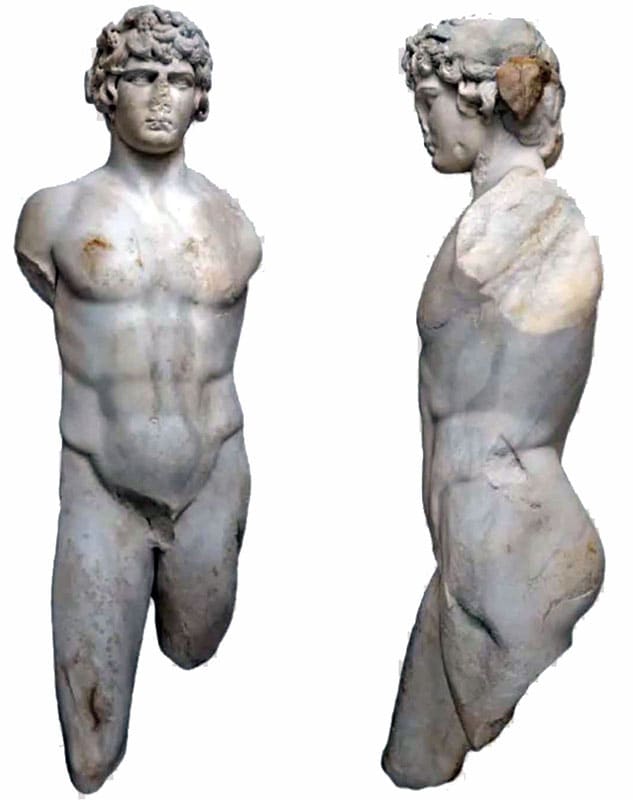
Marble statue of Antinoos found near Myloi, shown from the front and the side. Visit Myloi
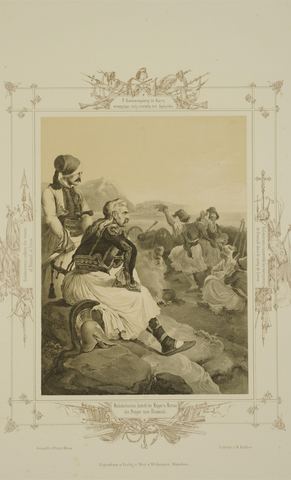
Lithograph "Kolokotronis gathers the victors over Dramalis at Lerna" (1822 camp scene) with a four-language caption; idealised landscape. Peter von Hess (painter), H. Kohler (lithographer), Mey & Widmayer, Munich; National Historical Museum, Athens
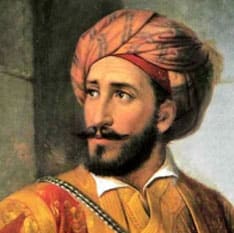
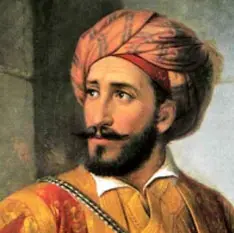
Portrait of Ioannis Makriyannis. Visit Myloi collection
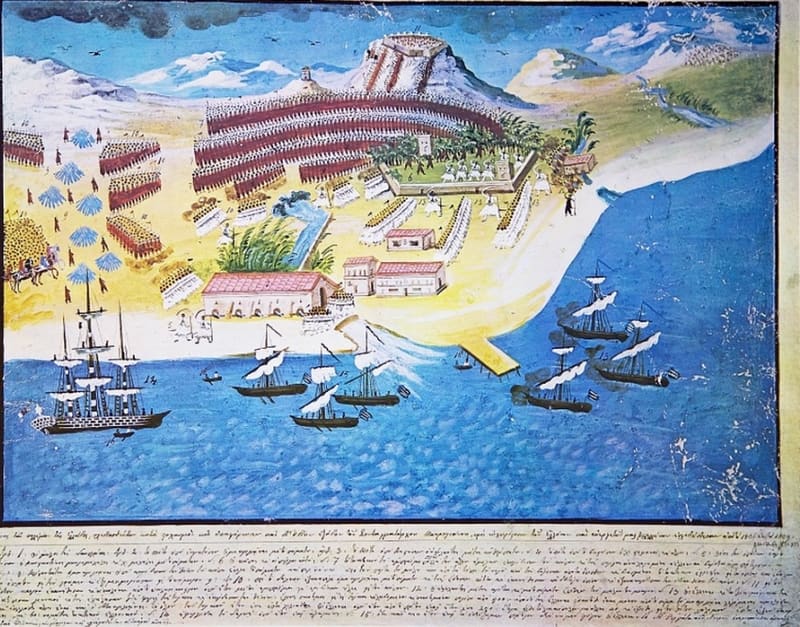
Panagiotis Zografos for General Makriyannis (c. 1836–39), plate 14: the Battle of the Mills (Myloi) near Nafplio, June 1825. Public domain
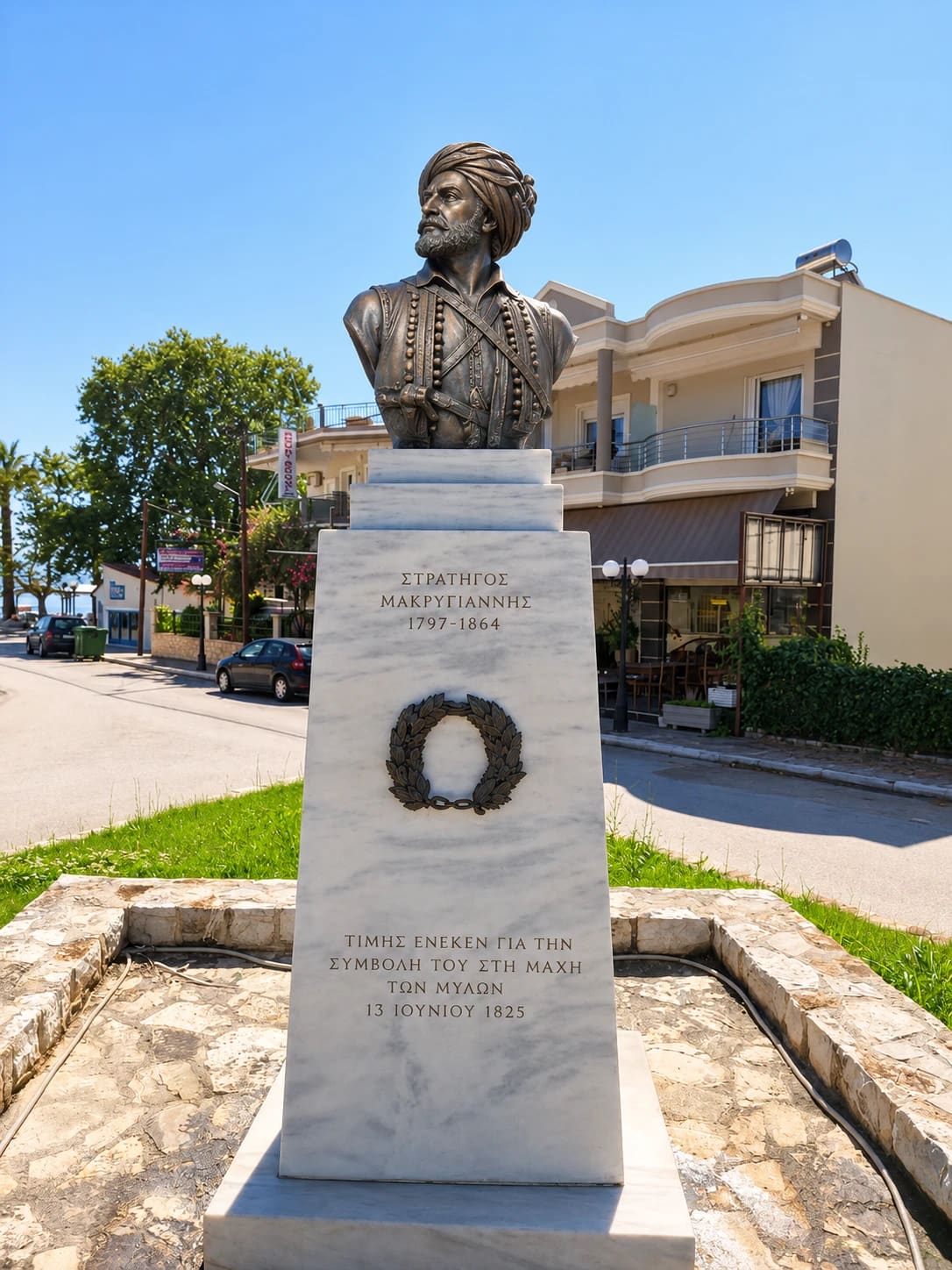
The bronze bust of General Makriyannis (1797–1864) in Myloi, on a marble pedestal “in honour of his contribution to the Battle of the Mills, 13 June 1825”. Visit Myloi
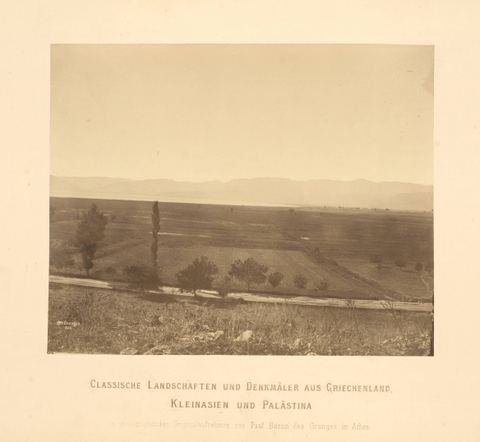
'Der Golf von Argos in der Gegend des lernaischen Sumpfes von Tirynth aus': the plain of Argos with roads and poplars, and on the horizon the west coast of the gulf with Lerna/Myloi and the mountains. Paul baron des Granges; Fonds des Granges, Institut d'Archéologie classique, Université de Strasbourg (no. 282, ARM VI, 15)
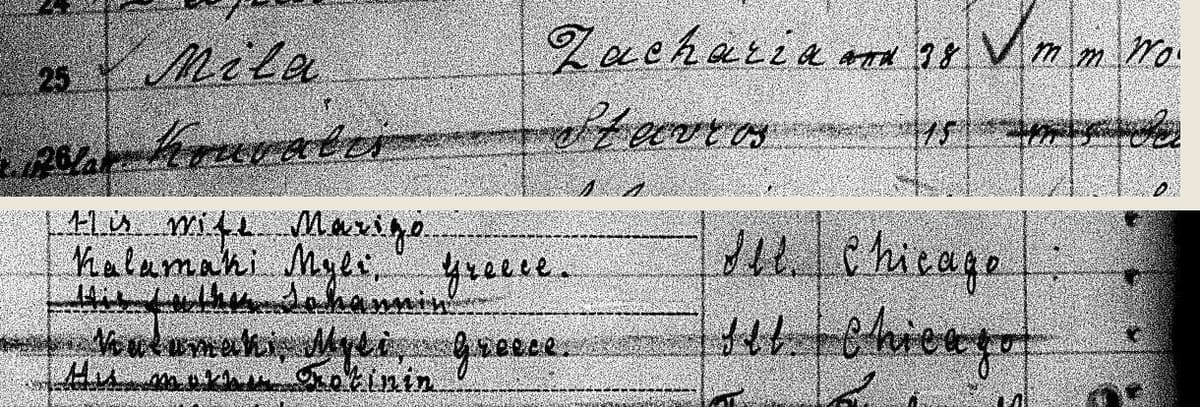
The passenger list of the Patris, April 1911, lines 25–26: "Mila, Zacharia, 38" and "Kouvalis, Stavros, 15". Below: their families at home, "his wife Marigo" and "his father Johannis", both in "Kalamaki, Myli, Greece", and their destination: "Ill. Chicago". NARA T715, via FamilySearch

The back of the same sheet. Mila had been in the United States before ("yes, 1902–1906, Chicago, Ill.") and was going to "his brother-in-law Angelos Kouvalis, 417 N. Wells, Chicago Ill." For Stavros: "the same, as above". NARA T715, via FamilySearch
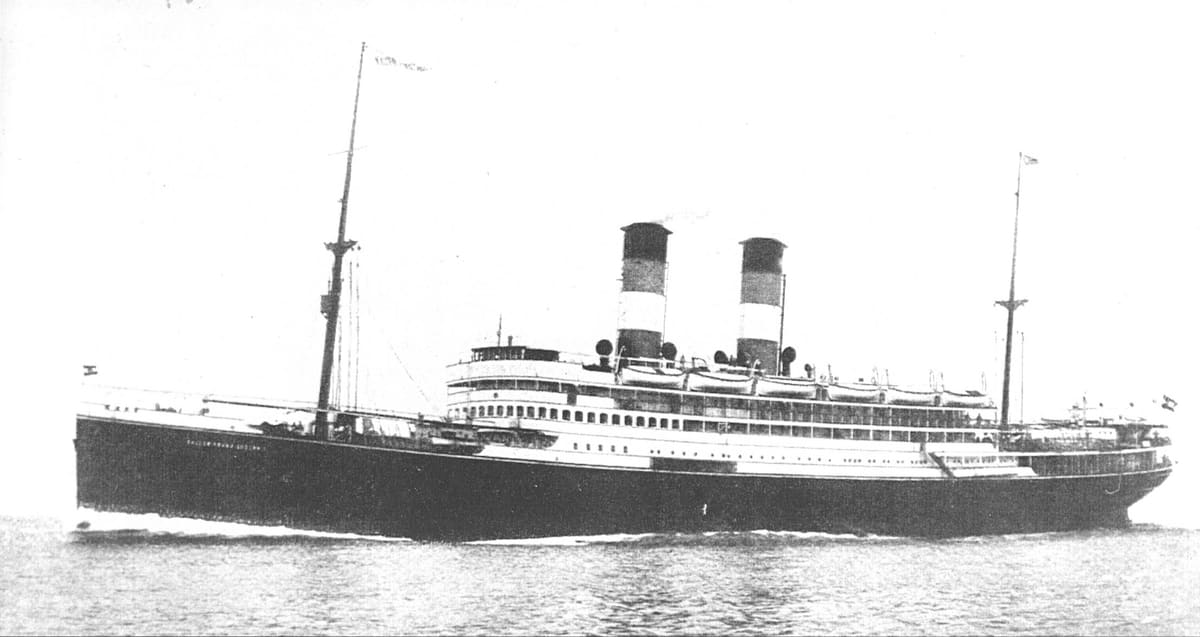
The Kaiser Franz Josef I, the largest passenger ship of Austria-Hungary, brand new in 1912. Zachos Antoniou crossed on her in August 1912, in steerage. Unknown photographer, c. 1912 (public domain)

The Pannonia, June 1914, line 10: "Antoniou, Zacharias, 24, workman", residence "Mylous", nearest relative "his father C. Antoniou, Mylous, Greece". NARA T715, via FamilySearch
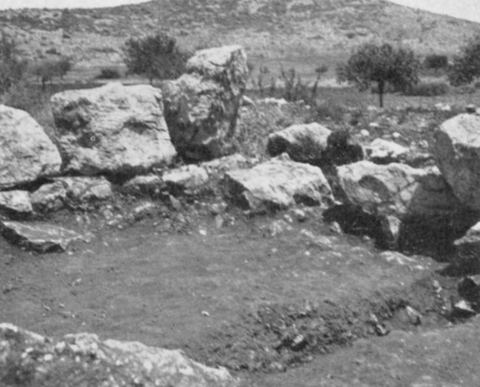
Fig. 22 'Blockhouse Near Lerna, N.E. Corner, Showing Entrance': excavated wall corner of the late-antique blockhouse c. 3 km beyond the spring of Lerna, with bare hills and olive trees behind. Excavation by Alison Frantz and Carl A. Roebuck (ASCSA); photos almost certainly by them
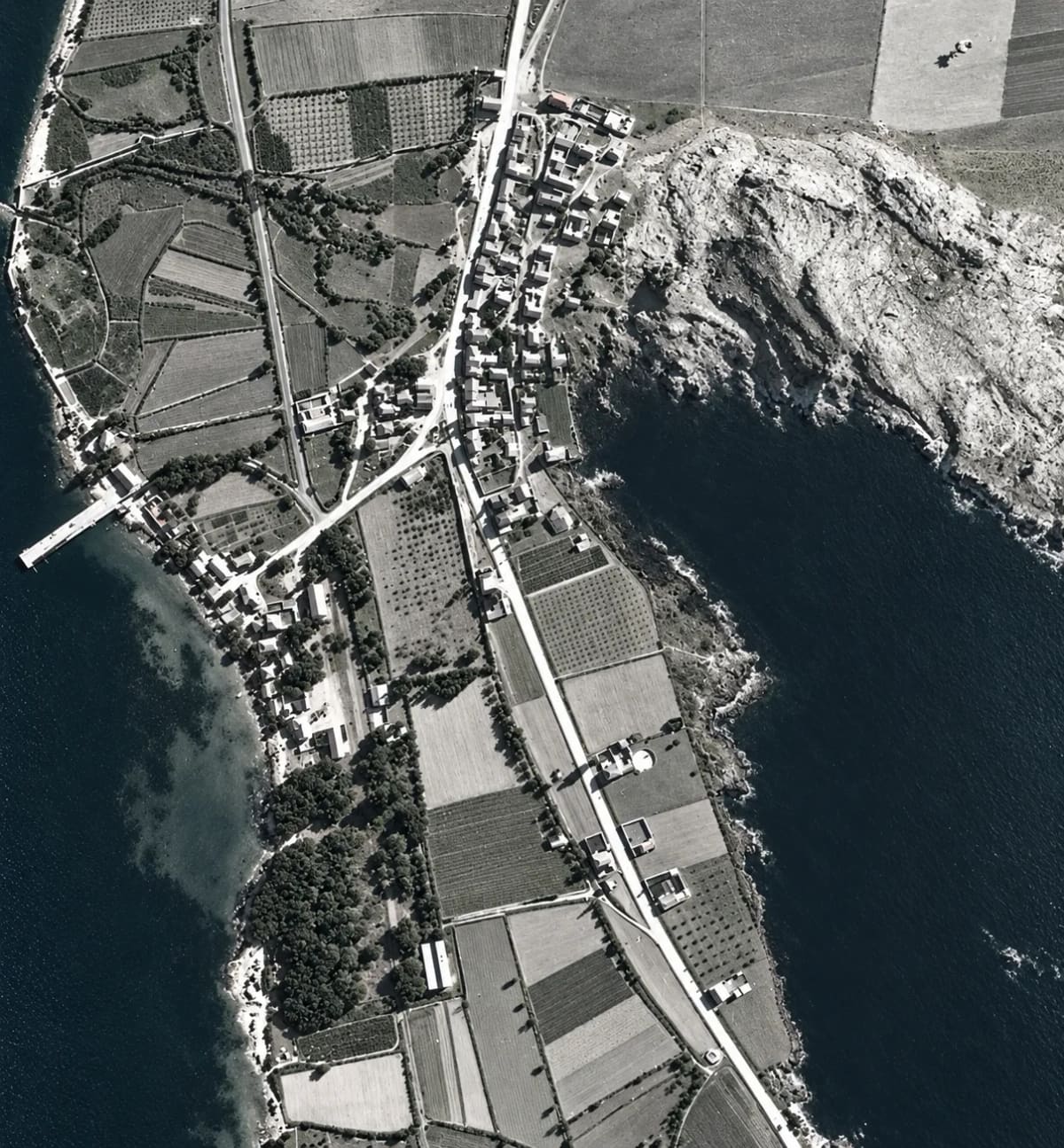
Myloi from a German reconnaissance flight, 1941–1942: the village along the main road, the pier, the station, the orchards and the rocks of Pontinos (digitally restored). Reichsluftfahrtministerium (Sonderluftbildabteilung); DAI Athens Archive