
Revolution and liberation · The Revolution of 1821 · Water and mills
Makriyannis fortifies the mills
June 1825 Proven
Makriyannis and the war minister Andreas Metaxas chose to stop Ibrahim at Myloi, then a hamlet of about thirty houses. Makriyannis built ramparts, cut loopholes in the garden wall and strengthened the old stone tower. The mills could also supply Nafplio with water if its aqueduct was cut.
Read the full story: Myloi, 200 years ago: the battle broke out
- Certainty
- Proven confirmed by primary sources
Pictures
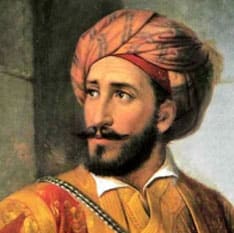
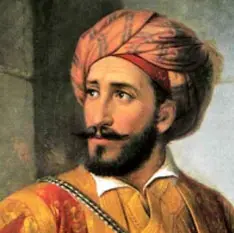
Portrait of Ioannis Makriyannis. Visit Myloi collection
Sources
- I. Makriyannis, Memoirs (Απομνημονεύματα)
- visitmyloi.gr, 'Myloi, 200 years ago: the battle broke out' (after History of the Greek Nation XII)
- S. G. Howe, An Historical Sketch of the Greek Revolution, New York 1828, ch. III (1825) Open (opens in a new tab)
Also in this period
-
1822–1826
A German volunteer describes fortified Myli
The philhellene Gottfried Müller from Bremen wrote that Myli had several long houses along the sea and a former Turkish garden with a high wall, which the Greeks had turned into a stronghold. The spring drove a mill with…
-
July 1822
Kolokotronis makes the mills his headquarters
In the summer of 1822, as Dramali's army stood in the plain of Argos, Theodoros Kolokotronis made the mills of Lerna his headquarters. According to Samuel Howe he gathered up to 6,000 armed peasants there before the…
-
July 1822
The Greek senate takes refuge at Myli
When Dramali's Ottoman army poured into the Argolid in July 1822, the Greek senate fled to Myli. Dimitrios Ypsilantis fell back there with about 600 men, taking position between the sea and the foot of the steep…
-
24 November 1822
A police overseer for the Mills
During the War of Independence Myloi was a harbour and a supply point, so the revolutionary government gave it its own police official. Andreas Papadiamantopoulos was appointed "overseer of the police at Myloi". These…