
Antiquity · Ancient Lerna
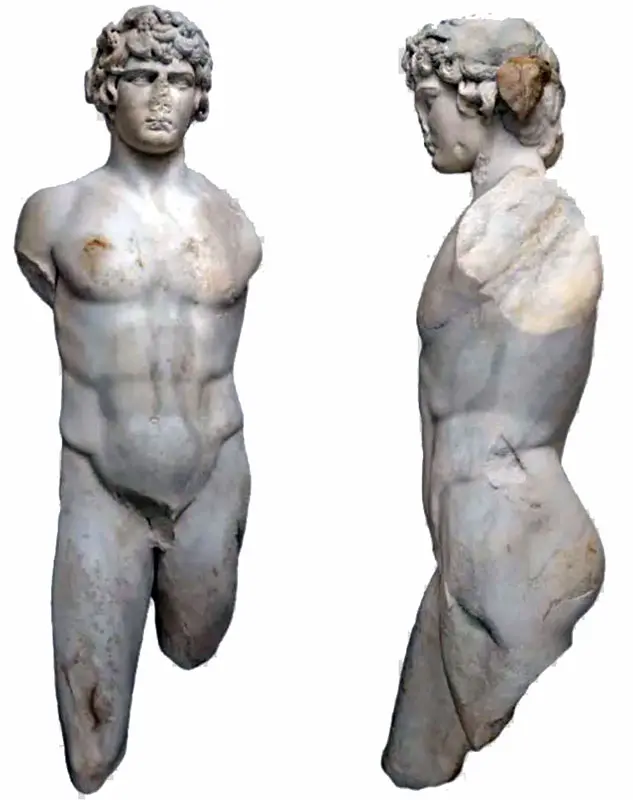
A statue of Antinoos in a sanctuary near Lerna
130–199 Probable
After Antinoos, the young favourite of Emperor Hadrian, drowned in the Nile in 130 AD and was declared a god, statues of him were set up across the empire. One of them, slightly larger than life and crowned with ivy like the god Dionysus, stood in a small Roman sanctuary just outside today's Myloi, probably dedicated to Demeter and Dionysus. Archaeologists found it there in 1986; it is now in the Archaeological Museum of Argos.
Note: The statue itself is not precisely dated; 130 AD, the year Antinoos was deified, is the earliest possible date.
Read the full story: Antinoos in Myloi: a marble mystery from the Roman past
- Where
- Myloi (the village)
- Threads
- Ancient Lerna
- Certainty
- Probable likely, but not fully proven
Pictures
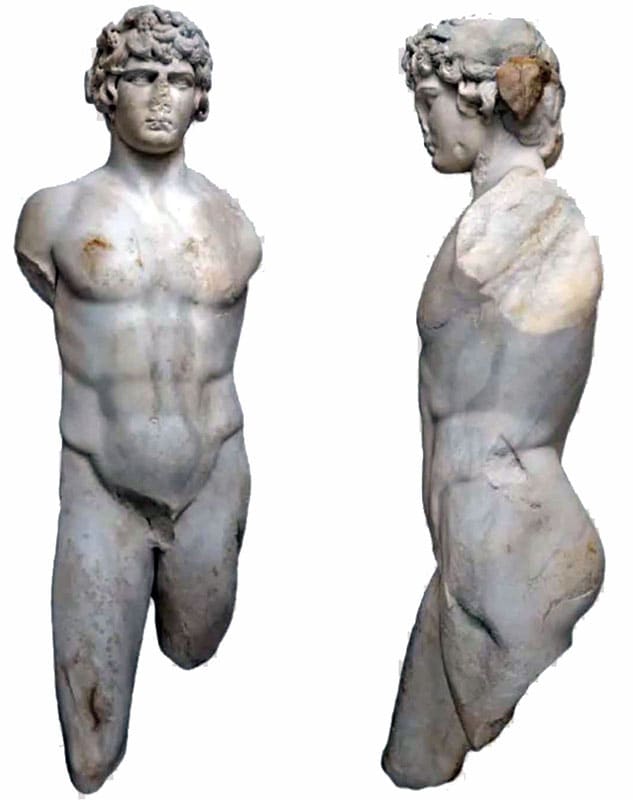
Marble statue of Antinoos found near Myloi, shown from the front and the side. Visit Myloi
Sources
- Visit Myloi, «Antinoos in Myloi: a marble mystery from the Roman past», after the Ephorate of Antiquities of Argolida (excavation of 1986)
- Archaeological Museum of Argos (Ephorate of Antiquities of Argolida)
Also in this period
-
6000 BC – 3200 BC
First farmers settle by the springs of Lerna
In the Neolithic, more than 6,000 years ago, farmers settled on a low rise beside the springs, just south of today's village. Each generation built on the ruins of the last, so the settlement mound of Lerna slowly grew.…
-
2500 BC – 2200 BC
The House of the Tiles
At the centre of Early Bronze Age Lerna stood a large two-storey building roofed with baked clay tiles and stone slabs. Rows of seal impressions found inside show that goods were stored and checked here, so it probably…
-
c. 1250 BC
Lerna is abandoned
Lerna stayed inhabited into the Middle Bronze Age. In the Mycenaean period the hill was used mainly as a cemetery and lived on only now and then, and around 1250 BC it was abandoned for good.
-
c. 700 BC
Hesiod tells of the Hydra of Lerna
Around 700 BC the poet Hesiod is the first to write about the Hydra, the many-headed water serpent of the marshes of Lerna, killed by Heracles. In the later version of the story two heads grew back for every one he…