
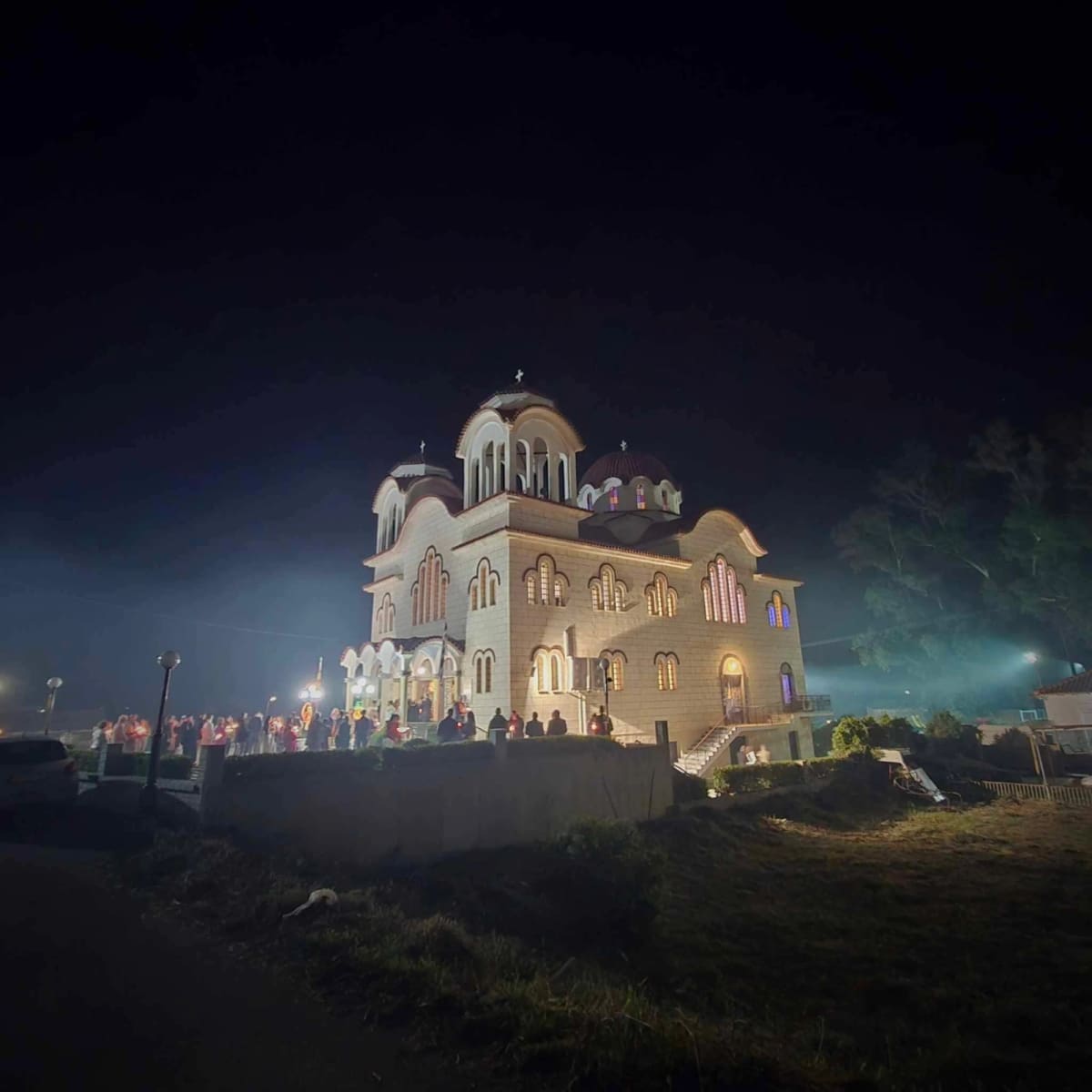
Faith and tradition
The churches of Myloi
Three churches mark the life of the village: the parish church in the centre, a chapel by the springs and a small white chapel high up in the castle. And on the same hill lie the ruins of a fourth, forgotten for centuries.
In a Greek village the church is more than a building. It is where the year is marked: Easter, the feast of the saint, weddings, baptisms and remembrance. On the saint's feast day, the panigyri, the whole village comes together, often with music and food after the service.
Visitors are welcome. Please dress modestly (shoulders and knees covered), keep your voice low and ask before taking photographs during a service.
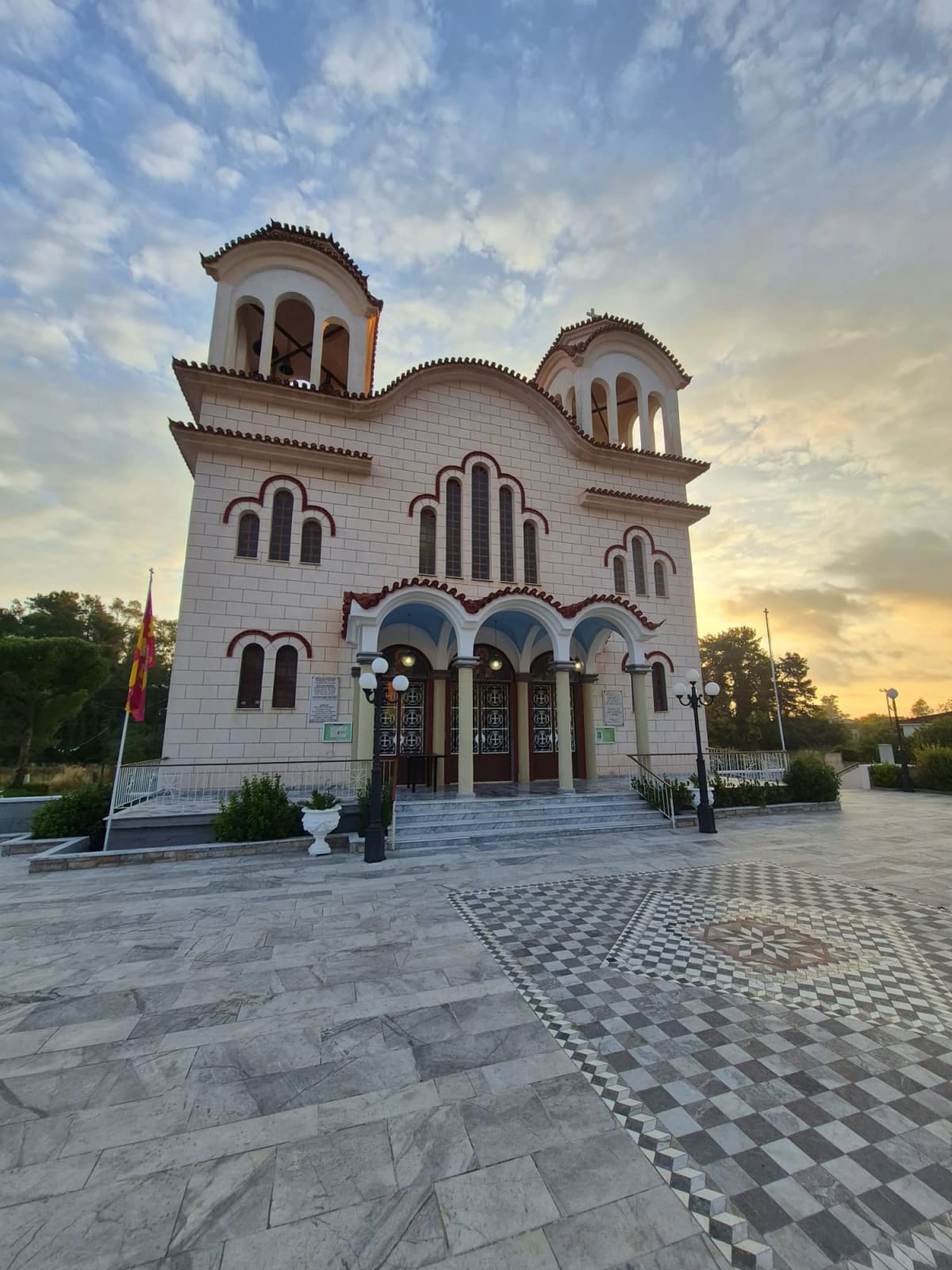
Parish church, village centre
Church of the Holy Apostles
Feast day 30 June
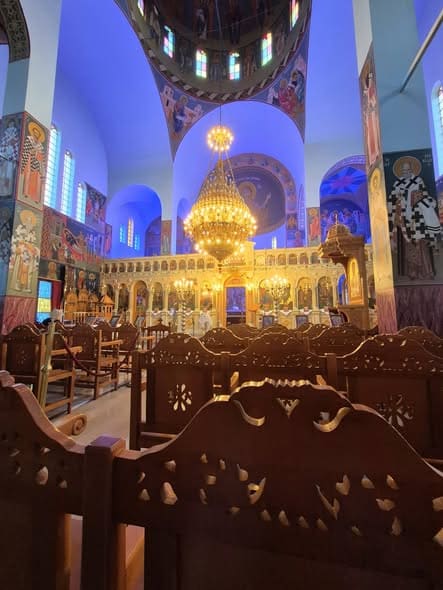
The large white church with its two bell towers and red domes stands in the heart of the village, close to the old railway station. Inside, a golden chandelier hangs in front of the painted iconostasis.
The saint
The church is dedicated to the Holy Apostles. On 30 June the Orthodox Church celebrates the Synaxis of the Twelve Apostles, the day after the feast of Saints Peter and Paul; it is also the name day of the parish church of Myloi.
Twelve fishermen and followers
The Twelve were the disciples Jesus chose to follow him: Peter and his brother Andrew, James and John, the sons of Zebedee, Philip, Bartholomew, Thomas, Matthew the tax collector, James son of Alphaeus, Jude Thaddeus, Simon the Zealot and Matthias, who took the place of Judas. Several of them were fishermen on the Sea of Galilee. After the Resurrection they carried the Gospel far beyond Palestine; tradition sends Andrew to Greece, where he was martyred at Patras, and Thomas as far as India.
The feast on 30 June
The Synaxis of the Twelve Apostles comes at the end of the Apostles’ Fast, which begins a week after Pentecost and ends on 29 June with the feast of Saints Peter and Paul. On the 30th the Church honours all twelve together. In the icon of the feast the Apostles stand side by side, each with his own recognisable features: Peter with short grey curly hair and beard, Andrew with unruly white hair, John young and beardless.
More to come
We are gathering the history of this church: when it was built, its interior and icons, and the life of the parish today. If you have old photographs or stories, please share them with us.
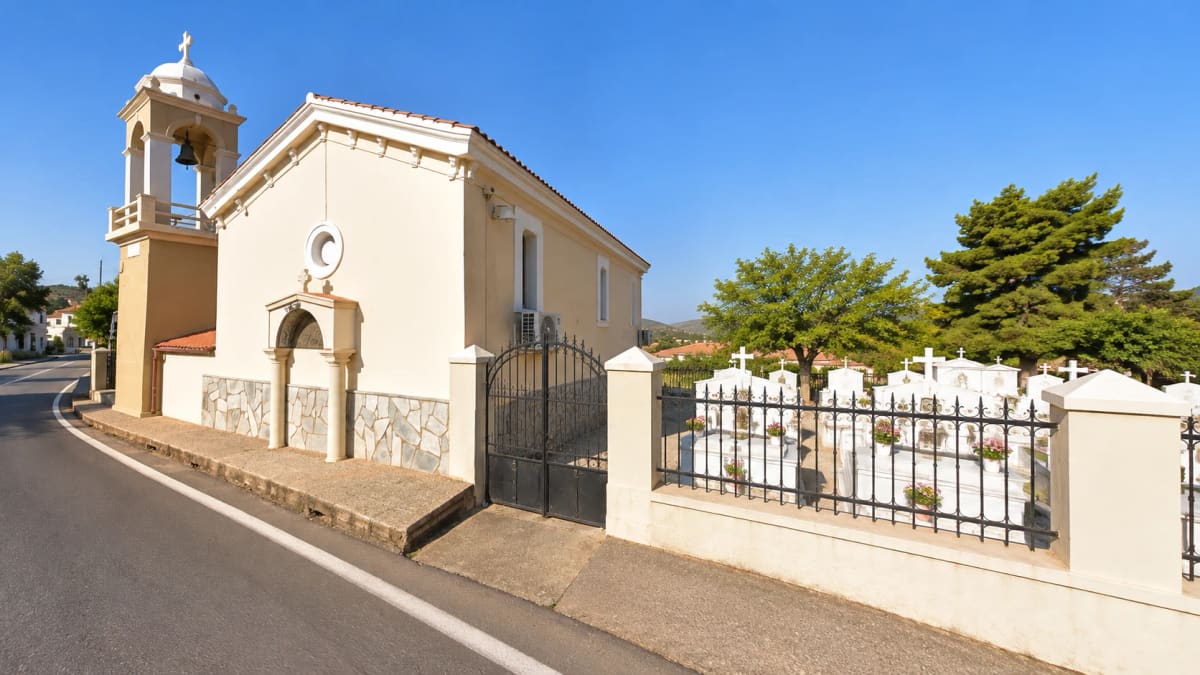
South of the village, near the springs of Lerna
Church of Agios Dimitrios
Feast day 26 October
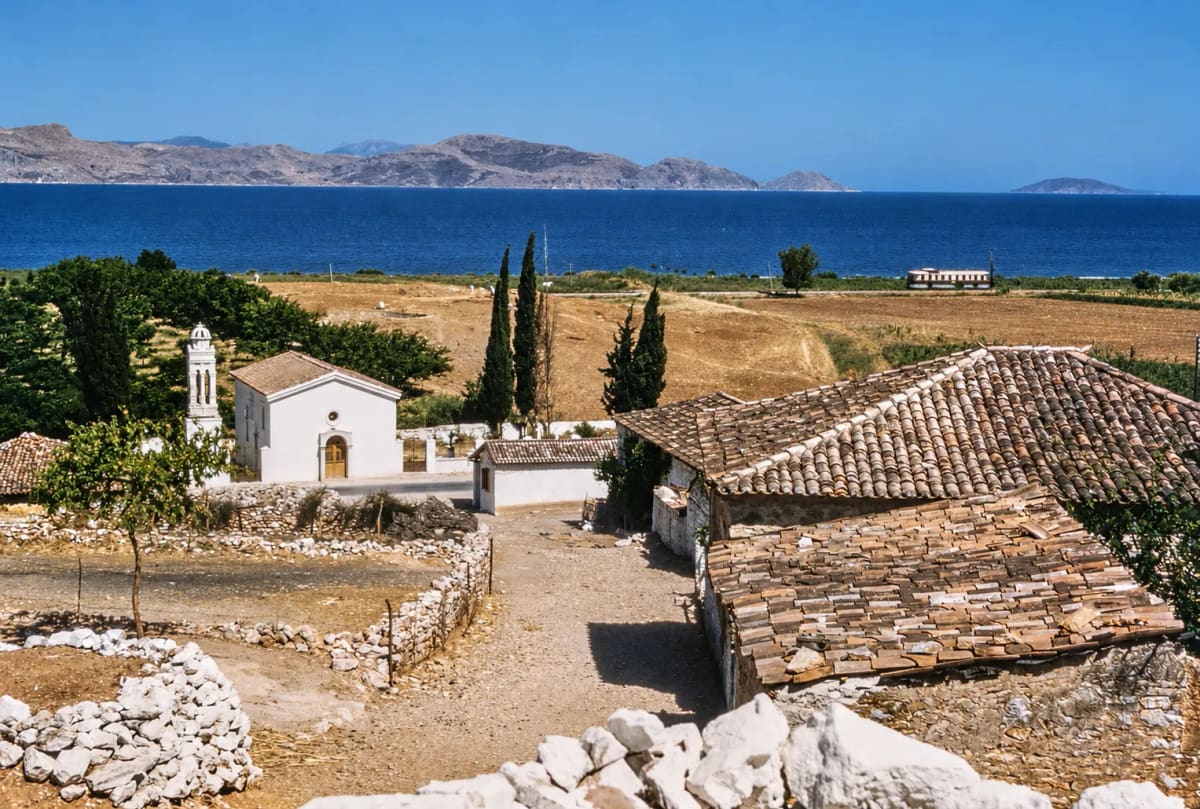
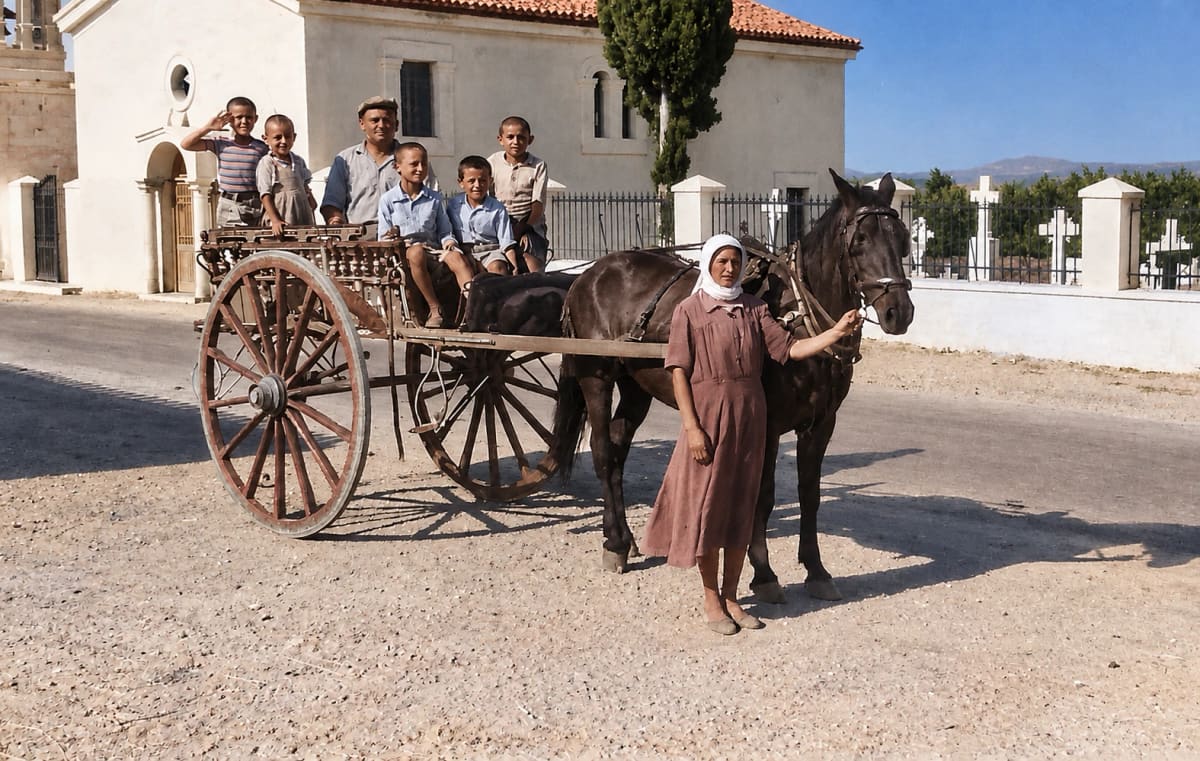
The church stands on the southern edge of the village, near the cemetery and the springs of Lerna. It is one of the stops on the Visit Myloi walking route.
The saint
Saint Demetrios of Thessaloniki was a Christian martyr of the early 4th century, put to death under the Roman emperors. He is one of the most loved saints in Greece and the patron saint of Thessaloniki, often shown as a young soldier on horseback.
The soldier-martyr of Thessaloniki
According to his Life, Demetrios came from a noble family of Thessaloniki and served as an officer in the Roman army. When it became known that he was teaching the Christian faith, he was imprisoned in a bathhouse and there, around 306, killed with spears on the emperor’s orders. Shortly before, the young Nestor, with his blessing, had defeated the emperor’s favourite gladiator, Lyaeus, in the arena. A great basilica was later built over the place of his martyrdom; it still stands in the centre of Thessaloniki.
The myrrh-gusher and the little summer
Demetrios is called the Myrovlytis, the myrrh-gusher, because fragrant oil was said to flow from his tomb. His feast on 26 October often falls in a spell of mild autumn weather that Greeks call “the little summer of Saint Demetrios”. In many places it also marked the end of the farming year: the new wine is opened, and in earlier times shepherds and farm workers settled their agreements around this date.
More to come
We are gathering the history of this church: when it was built, its interior and icons, and the life of the parish today. If you have old photographs or stories, please share them with us.
Inside the castle on Pontinos hill
Chapel of Profitis Ilias
Feast day 20 July
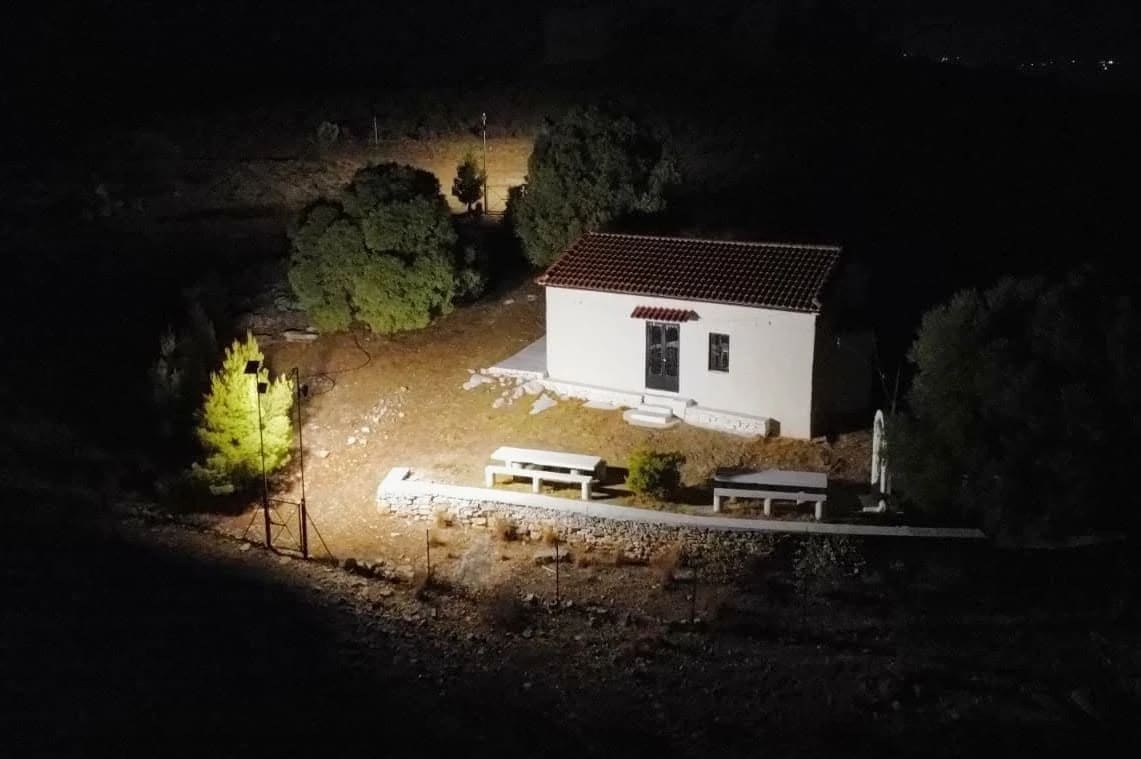
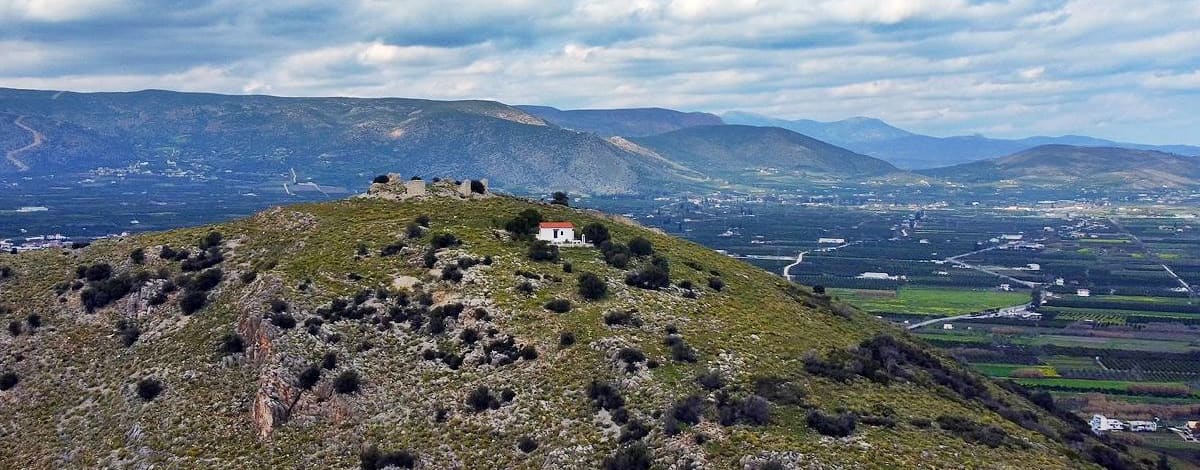
True to that tradition, the small white chapel of Profitis Ilias stands within the walls of the medieval castle on the summit of Pontinos, with a wide view over the village, the Argolid plain and the gulf. It is reached on foot from the village.
The saint
The prophet Elijah of the Old Testament, who according to the Bible was taken up to heaven in a chariot of fire. All over Greece his chapels stand on hilltops and mountain peaks, close to the sky.
The prophet of fire and rain
Elijah lived in the kingdom of Israel in the 9th century BC, under King Ahab and Queen Jezebel. The Bible tells how he announced a drought of three years, was fed by ravens in the wilderness and on Mount Carmel challenged the prophets of Baal: fire from heaven consumed his offering, and soon afterwards the rain returned. At the end of his life he was taken up to heaven in a chariot of fire, which is why the Orthodox Church honours him as a prophet who never died.
Why on the hilltops
In Greek popular belief Profitis Ilias rules over rain, thunder and lightning; when it thundered, people said the prophet was driving his chariot across the sky. Some scholars see in this an echo of the ancient sun god Helios, whose name sounds like Ilias. Whatever the origin, his chapels stand on summits all over Greece, and on his feast day, 20 July, people climb up to them for the liturgy.
More to come
We are gathering the history of this church: when it was built, its interior and icons, and the life of the parish today. If you have old photographs or stories, please share them with us.
Ruin in the castle on Pontinos, 14th century
The lost church in the castle
Ruin Feast day: Unknown
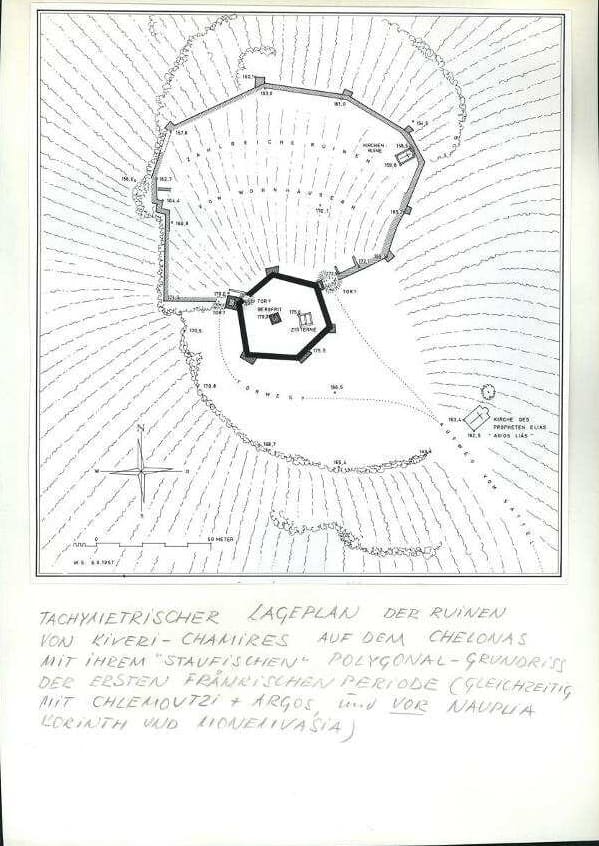
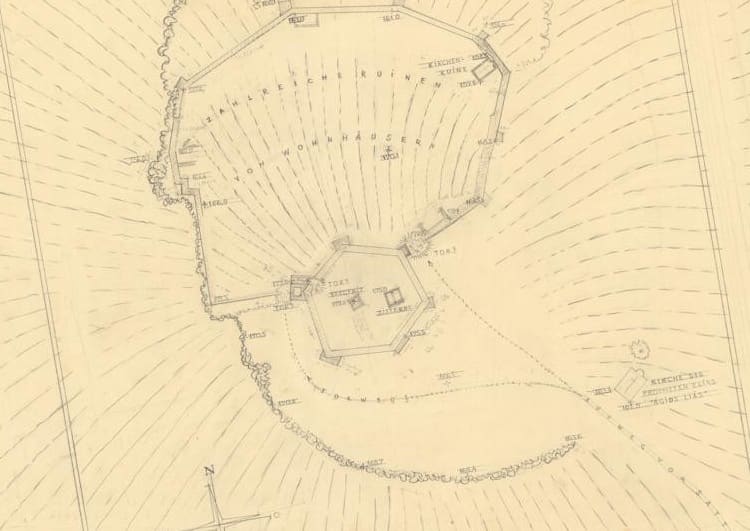
Myloi has three churches in use, and a fourth that was forgotten for centuries. On a German survey plan of the castle drawn in 1957, a small building against the eastern wall of the outer ward is marked “Kirchenruine”: church ruin.
What the archaeologists found
The ruin has since been studied. It is a small church with a single room, about 9.00 by 4.80 metres, with a semicircular apse at the east end. The apse rests on the castle wall, which bends outward at that point to make room for it. The sanctuary had a paved floor raised by one step, and there is no trace of a built altar or of an iconostasis. For the researchers these are signs that it was a Latin, Roman Catholic church, built for the Frankish lords of the castle. That is a strong indication, not a proof.
A priest who had to stay
In his will of 1347, Gautier VI de Brienne, Lord of Argos and Nauplia, left sixty hyperpyra, Byzantine gold coins, every year for a church and its priest at his estate of Kiveri. The money was to come from the rent of a shop in Argos where cloth was sold. In return, the priest had to live at the castle permanently and celebrate mass every day. Another fifty hyperpyra were set aside for the church's books, vessels and furnishings. Whether this was the same building cannot be proven. But somewhere on Pontinos hill, a priest once said mass every morning above the Argolid plain, because his lord had wished it.
What we do not know
The name of the church, its saint, the exact date it was built and the identity of the priest are still unknown.
Source: I. Varalis, K. Bountouris, G. Tsekes, ‘Το Λατινικό κάστρο CHIVERI στους Μύλους Λέρνας’ (conference Fortification architecture in the Peloponnese, Loutraki 2011), and the will of Gautier VI de Brienne (1347), both as cited by Argoliki Vivliothiki, ‘The Chamires castle’ (10 Sept 2026); W. E. McLeod, ‘Kiveri and Thermisi’, Hesperia 31 (1962) 378–392.
Church calendar
The days when the churches of Myloi come alive. Feast-day celebrations usually begin with vespers on the evening before.
-
6 January
All of Greece
Epiphany (Theophania)
Blessing of the waters; in many coastal villages a cross is thrown into the sea.
-
Moveable: 48 days before Easter
All of Greece
Clean Monday (Kathara Deftera)
Start of Lent: kites, picnics and lenten food.
-
25 March
All of Greece
Annunciation and Independence Day
Church feast and national holiday, with services and school parades.
-
Orthodox Easter: 12 April 2026 · 2 May 2027 · 16 April 2028
All of Greece
Holy Week and Easter
The most important feast of the year: the Epitaphios procession on Good Friday, the midnight Resurrection service with candles on Saturday night, and Easter Sunday with lamb on the spit.
-
30 June
Myloi
Feast of the Holy Apostles
Name day of the parish church of Myloi.
-
20 July
Myloi
Prophet Elijah (Profitis Ilias)
Feast of the chapel in the castle on Pontinos.
-
15 August
All of Greece
Dormition of the Virgin Mary
The great summer feast of Greece, celebrated in every parish.
-
26 October
Myloi
Saint Demetrios
Feast of the church of Agios Dimitrios.
-
25 December
All of Greece
Christmas
Morning service on Christmas Day; children sing the kalanta on Christmas Eve.
Service times are announced by the parish. Exact times for Myloi will be added here.