
Antiquity · Ancient Lerna · Travellers
Pausanias visits Lerna and Mount Pontinos
c. 160 Proven
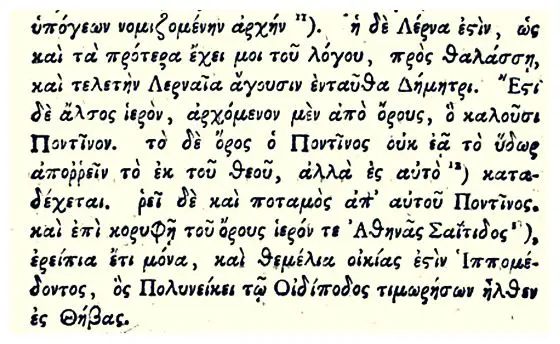
The Greek travel writer Pausanias describes the sacred grove of plane trees that began at Mount Pontinos, the mysteries held there for Lernaean Demeter, the spring of Amymone and the bottomless Alcyonian lake. On the summit of Pontinos he saw a sanctuary of Athena Saitis, already in ruins, and the foundations of the house of Hippomedon, one of the Seven against Thebes. He is the first eyewitness to describe the place in detail.
- Who
- Pausanias
- Threads
- Ancient Lerna, Travellers
- Certainty
- Proven confirmed by primary sources
Pictures
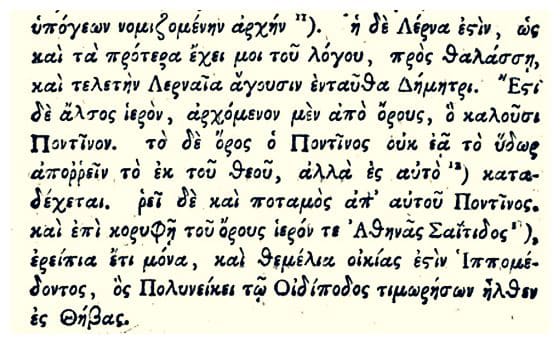
Pausanias’ own words about Lerna and Mount Pontinos (Description of Greece 2.36–37), in Greek, from an old printed edition. Visit Myloi collection
Sources
- Pausanias, Description of Greece 2.36.8–2.37.6
Also in this period
-
6000 BC – 3200 BC
First farmers settle by the springs of Lerna
In the Neolithic, more than 6,000 years ago, farmers settled on a low rise beside the springs, just south of today's village. Each generation built on the ruins of the last, so the settlement mound of Lerna slowly grew.…
-
2500 BC – 2200 BC
The House of the Tiles
At the centre of Early Bronze Age Lerna stood a large two-storey building roofed with baked clay tiles and stone slabs. Rows of seal impressions found inside show that goods were stored and checked here, so it probably…
-
c. 1250 BC
Lerna is abandoned
Lerna stayed inhabited into the Middle Bronze Age. In the Mycenaean period the hill was used mainly as a cemetery and lived on only now and then, and around 1250 BC it was abandoned for good.
-
c. 700 BC
Hesiod tells of the Hydra of Lerna
Around 700 BC the poet Hesiod is the first to write about the Hydra, the many-headed water serpent of the marshes of Lerna, killed by Heracles. In the later version of the story two heads grew back for every one he…