
Antiquity · Ancient Lerna · Water and mills
Hesiod tells of the Hydra of Lerna
c. 700 BC Tradition
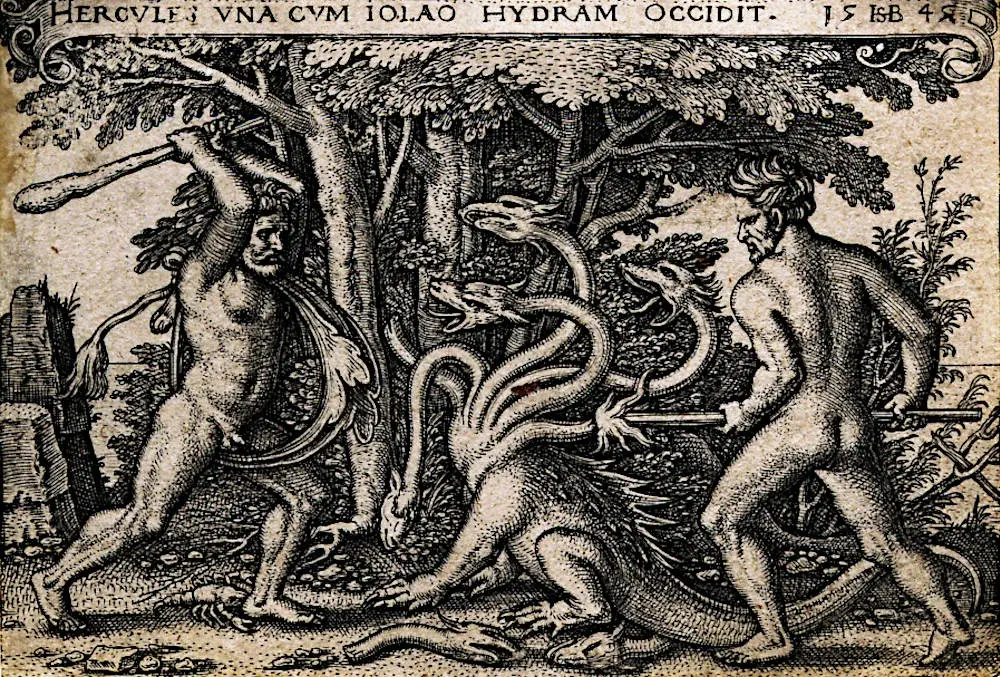
Around 700 BC the poet Hesiod is the first to write about the Hydra, the many-headed water serpent of the marshes of Lerna, killed by Heracles. In the later version of the story two heads grew back for every one he struck off, until his nephew Iolaos seared the stumps with fire. It is legend, not history, but it made Lerna famous throughout the ancient world.
Note: The date is that of the oldest written source. The myth itself is older and cannot be dated.
- Threads
- Ancient Lerna, Water and mills
- Certainty
- Tradition myth, legend or oral memory
Pictures
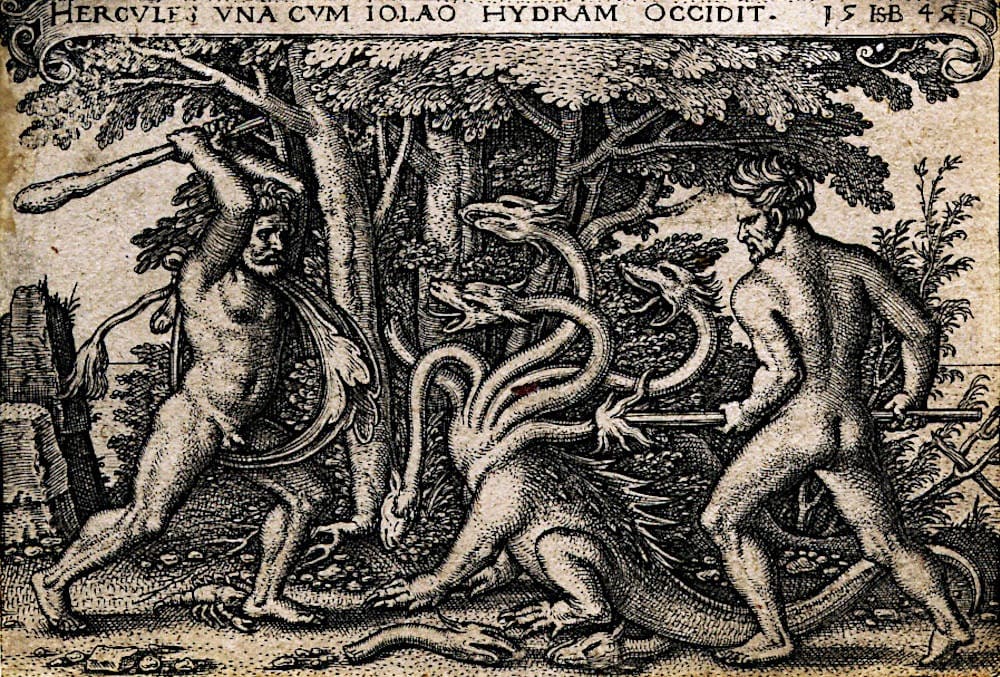
Engraving dated 1545, 'Hercules una cum Iolao Hydram occidit': Heracles and Iolaos slaying the Hydra (Labours of Hercules series, attributed to Hans Sebald Beham). Public domain
Sources
- Hesiod, Theogony 313–318
- Apollodorus, Library 2.5.2
Also in this period
-
6000 BC – 3200 BC
First farmers settle by the springs of Lerna
In the Neolithic, more than 6,000 years ago, farmers settled on a low rise beside the springs, just south of today's village. Each generation built on the ruins of the last, so the settlement mound of Lerna slowly grew.…
-
2500 BC – 2200 BC
The House of the Tiles
At the centre of Early Bronze Age Lerna stood a large two-storey building roofed with baked clay tiles and stone slabs. Rows of seal impressions found inside show that goods were stored and checked here, so it probably…
-
c. 1250 BC
Lerna is abandoned
Lerna stayed inhabited into the Middle Bronze Age. In the Mycenaean period the hill was used mainly as a cemetery and lived on only now and then, and around 1250 BC it was abandoned for good.
-
c. 67
Emperor Nero tries to find the bottom of the lake
Beside the springs lay the Alcyonian lake, said to have no bottom; through it, the Argives believed, Dionysus went down to the underworld to fetch his mother Semele. Pausanias tells that the emperor Nero had ropes many…