
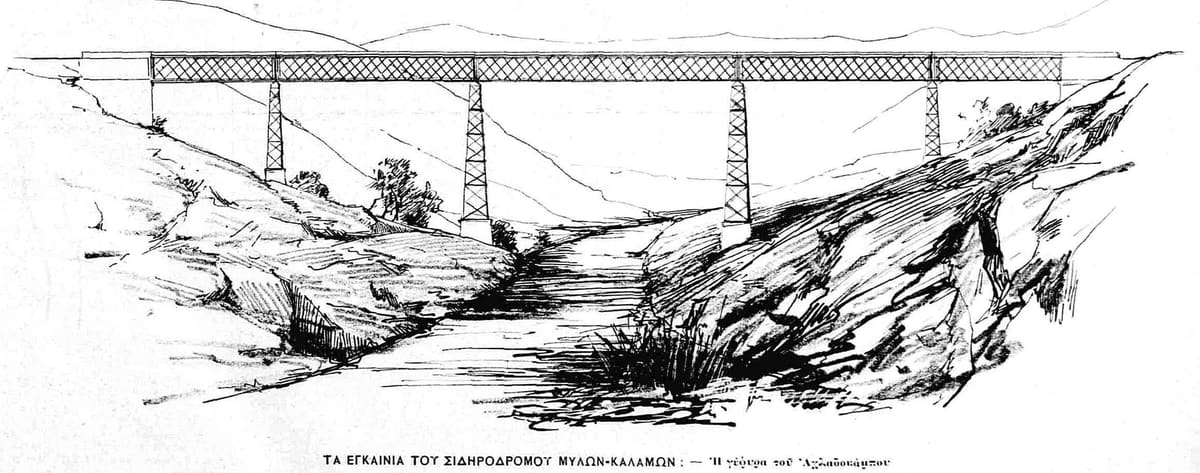
On the morning of 6 July 1891 a king stepped ashore at Myloi. That day the railway from Myloi into the mountains to Tripoli was opened, and two Athens newspapers sent reporters to see it. Their reports give us the liveliest picture we have of our village in the railway age.
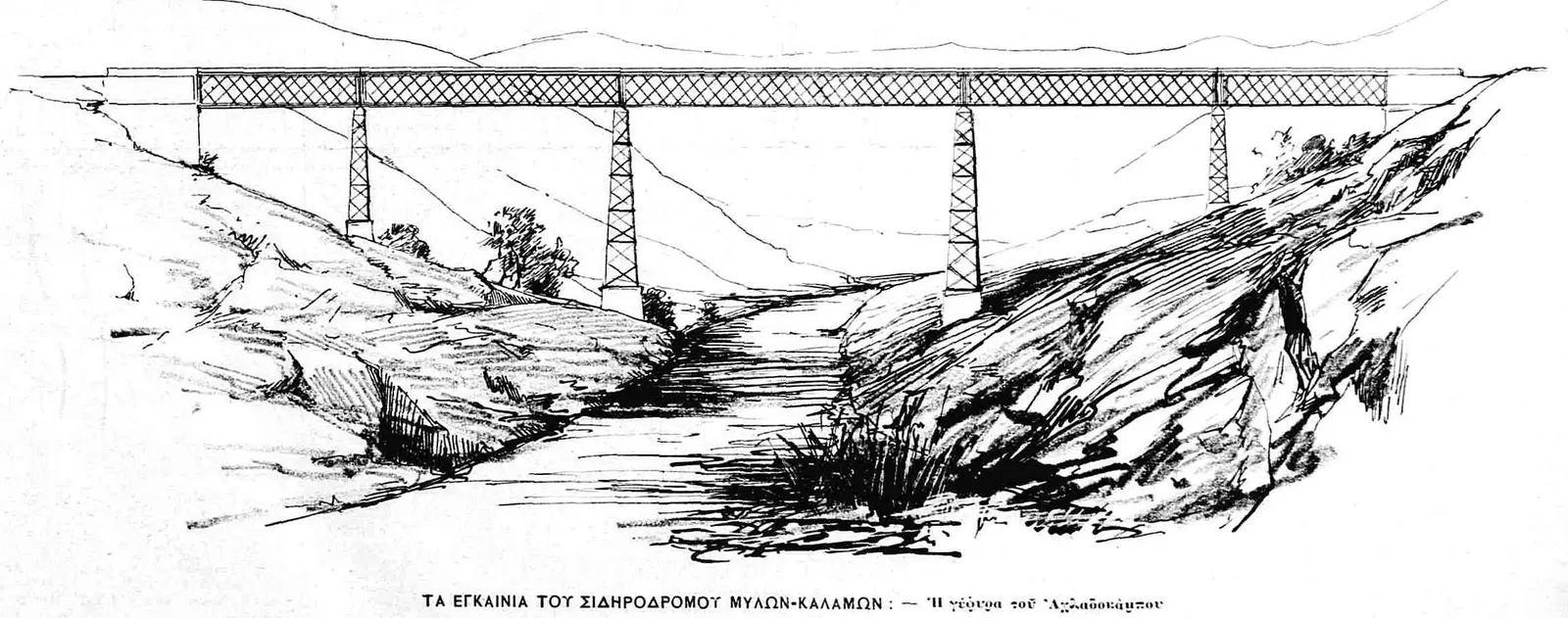
Six in the morning: a ship in the bay
The royal ship Sfaktiria came into the bay of Myloi at six in the morning, "after a fine crossing". As it passed Nafplio it was saluted with cannon fire. On board were King George I, his sons Prince Nikolaos and Prince Andreas, and Prime Minister Theodoros Deligiannis.
The guests had travelled the day before from Athens to Nafplio. That morning their train brought them to Myloi, left the dignitaries and journalists there, and then drove straight on to Tripoli. So the very first train up the new line was the guests' train, not the king's.
Eight o'clock: myrtle on the pier
At exactly eight the king went ashore, in a small admiral's uniform with the star of the Grand Cross on his chest. A crowd had gathered on the pier, which was decorated with myrtle and laurel, next to a triumphal arch hung with flags. The mayor of Argos, Kalmouchos, welcomed the king with a short speech. The king shook hands warmly with Ernest Rolin, the Belgian director of the building company, and then rode by train from the pier to the station.
The station was decorated with flags. In front of it the cavalry squadron from Argos stood in line, and the king inspected it with the princes. Then Archbishop Nikandros of Argolis blessed the new line with holy water. It was 34 degrees in the shade, and the archbishop, wrote Το Άστυ drily, "had the courage to stretch the ceremony to a full half hour". Even the carriages were blessed. "At last we see land," the reporter sighed when it was over.
Stowaways and a flask of wine
When the royal train left Myloi, cheered by the crowd, many uninvited people climbed onto the wagons to ride along to Tripoli. Twice the train stopped to get them off. According to Το Άστυ the gendarmes, who were "their friends", helped them back on every time. An old woman offered the king a flask full of wine and a silk handkerchief full of fruit.
Two days earlier heavy rain had damaged the line and the royal carriage had even come off the rails. The authorities had wanted to call off the king's journey, but the company's men repaired the track in time.
Back by evening
In Tripoli 140 guests sat down to a banquet. In the evening the trains came back down to Myloi. The king said goodbye and was rowed out in a launch to the Sfaktiria, which lay at anchor in the bay; the prime minister followed in another boat. At four in the morning the ship was in Piraeus.
Why this day matters
For years our website said that the line to Tripoli opened on 1 February 1892. The newspapers of 1891 show that it was opened on 24 June 1891 in the old Greek calendar, which is 6 July in ours. Ordinary passenger trains started running in August 1891. The line was the work of Charilaos Trikoupis, but it was his rival Deligiannis who opened it. A few months later the building company ran out of money and hundreds of workers went unpaid; that is a story for another day.
Sources
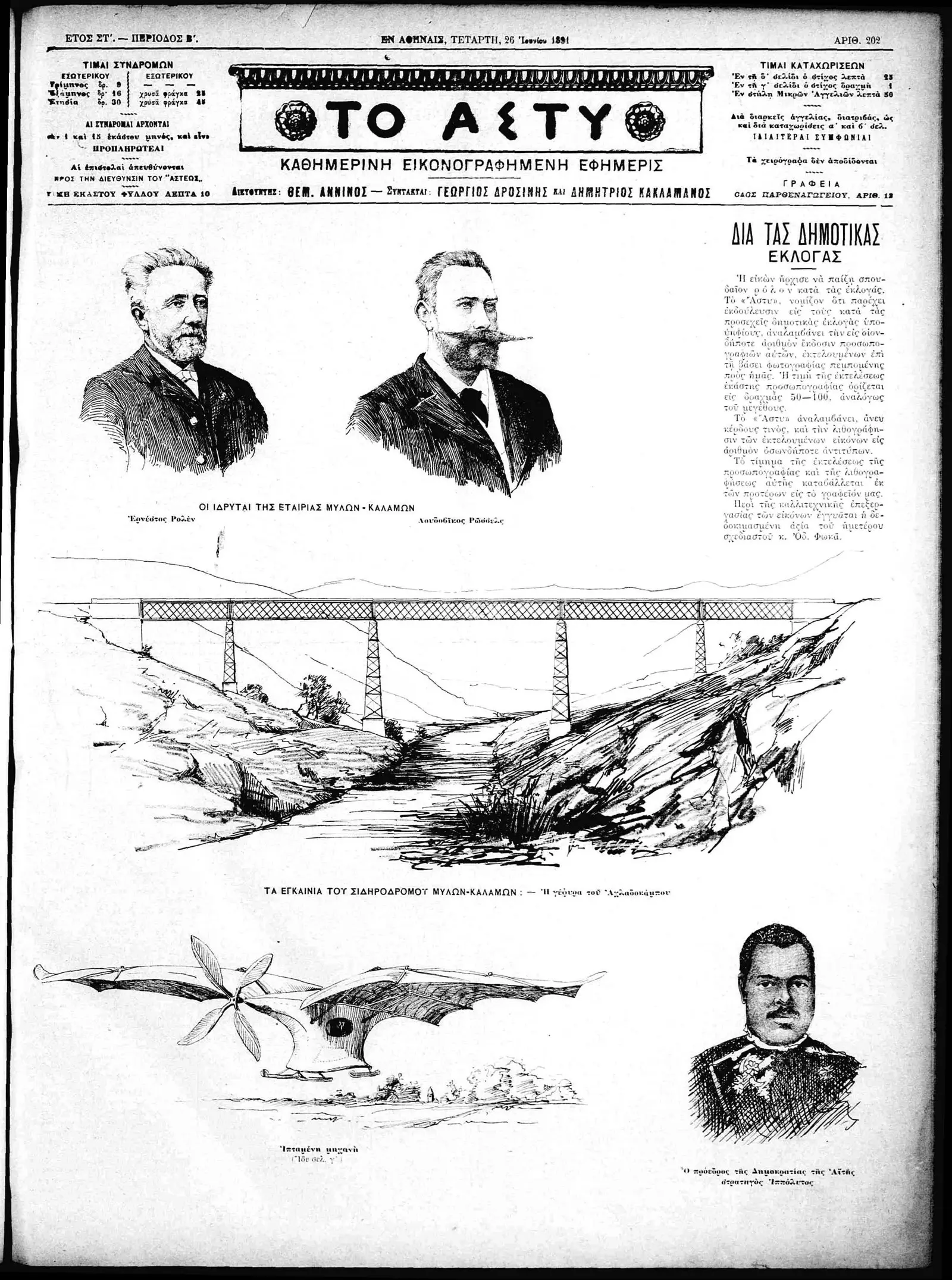
- Το Άστυ (Athens), 26 June 1891 old style, no. 202, pp. 1–2: «Τα εγκαίνια του σιδηροδρόμου Τριπόλεως». Hellenic Parliament Library, hdl 20.500.14199/5114438.
- Εφημερίς (Athens), 25 June 1891 old style, no. 176, p. 2: «Η εορτή των εγκαινίων από Μύλων εις Τρίπολιν». Hellenic Parliament Library.
- Πρωΐα, 4 August 1891 old style, and Νέα Εφημερίς, 5 August 1891: start of public service.
- Quotations translated by Visit Myloi from our own reading of the scans.