
For seven summers, American archaeologists dug in two brothers’ fields next to Myloi. Then they bought the best part of them. The story of George and Panayotis Kotsiopoulos, without whom Lerna would not look the way it does.
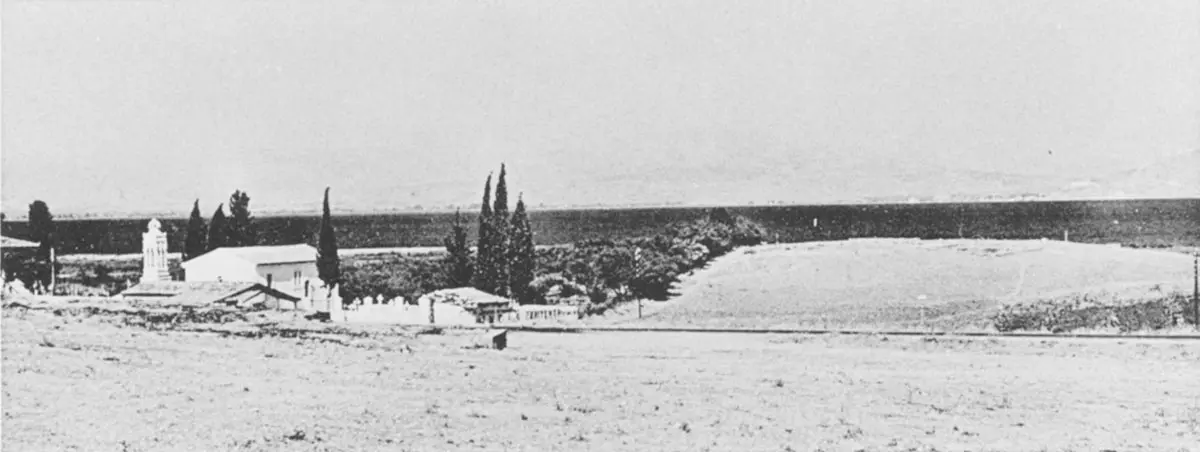
An orchard and some grain
In 1952 the low mound beside the road at Myloi was simply farmland. An orchard stood on the north side and grain grew on the south, the soil strewn with potsherds. The railway to Tripoli already cut through it, and gun positions had been dug into it during the war.
The land belonged to two brothers, George and Panayotis Kotsiopoulos. They did not live in Myloi but in Lithovouni and Steno, two villages near Tripoli in Arcadia, on the old road that descends via Achladokampos to Myloi.
“Permission freely given”
When John L. Caskey of the American School of Classical Studies wanted to dig in 1952, the brothers said yes. The first trial season began in September. Caskey thanked them for “permission freely given to dig in their fields”. Year after year the excavation grew, at times with more than thirty workmen, many of them from Myloi.
“A special word of appreciation is owed also to the brothers George and Panayotis Kotsiopoulos for their generous cooperation in allowing us to continue our work on their properties.”
J. L. Caskey, Hesperia 26 (1957)
20 August 1957
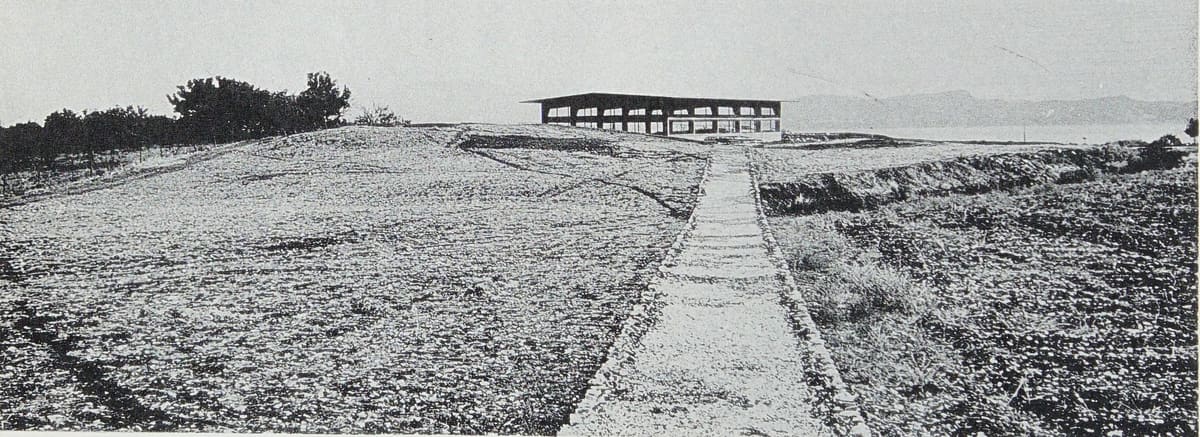
In the last summer of digging, on 20 August 1957, the brothers sold the heart of the site: the largest excavated area, with the House of the Tiles, and a pathway three metres wide and about a hundred metres long from the main road. That same month the modern shelter rose over the House of the Tiles, paid for partly by the Greek Ministry of Education. The other trenches were filled in, and that land went back to the plough.
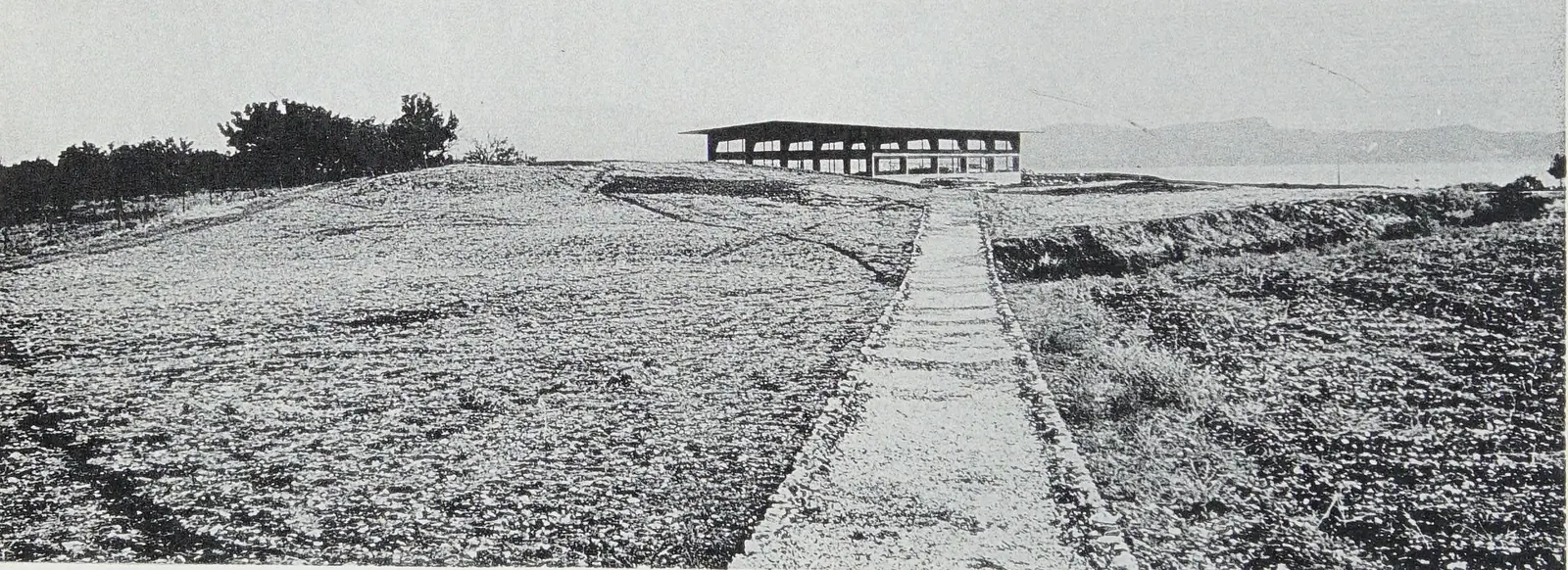
In the winter of 1958–59 the site was fenced and olive trees, oleanders and vines were planted. On 2 July 1959 the Americans handed Lerna over to the Greek Archaeological Service, and the community of Myloi made Caskey an honorary citizen. A former workman from Myloi, Manolis Mavrias, looked after the plants for years to come.
“… bought from the owners, George and Panayiotis Kotsiopoulos, who had generously and patiently allowed us to dig on their properties for seven years.”
J. L. Caskey, foreword to Lerna I (1969)
A dowry in the plain?
How did two men from the mountains own fields by the sea? A clue lies in a newspaper of May 1923: in Myloi, Giannoula N. Bouziou, a daughter of the village, married George D. Kotsiopoulos of Lithovouni. Her brother Konstantinos, who lived in Chicago, placed a note of congratulations in a Greek-American newspaper. In those days a bride often brought land as her dowry (proika). Perhaps this George was one of the two brothers; perhaps he was their father. If the dowry included fields by the mound, that would explain how a family from Arcadia came to own the land where Lerna lay hidden. It is the most likely explanation, though not yet proven.
The price and the size of the plot are still unknown too. The 1957 deed of sale is probably kept in the archives of the American School in Athens. To be continued.
Sources
- J. L. Caskey, “Excavations at Lerna, 1952–1953”, Hesperia 23 (1954), pp. 3–4; “Excavations at Lerna, 1956”, Hesperia 26 (1957); “Excavations at Lerna, 1957”, Hesperia 27 (1958), p. 141 and pl. 40b; “Activities at Lerna, 1958–1959”, Hesperia 28 (1959).
- N.-G. Gejvall, Lerna I (1969), foreword by J. L. Caskey, p. v.
- ASCSA, A History of the American School 1939–1980, chapter IX; Apogevmatini, 11 July 1957; Ethnikos Kiryx, 19 May 1923.