
Story · The trains of Myloi
Choo choo to Myloi!
For more than a hundred years, the station in Myloi was one of the busiest places in the village. Kostas tells you why.
The train comes to Myloi
Before there was a train, you travelled from Myloi to Tripoli by cart or on a mule, along a bad path through the mountains. That took a very long time!
On 4 August 1886 the first train ran from Argos to Myloi. After that, a new line was built from here, right through the mountains to Tripoli. That was hard work: the first train didn't head into the mountains until 1 February 1892.
Two stations in one village
At first, Myloi had TWO stations! There were two railway companies, and each company had its own station.
The small station closed in 1891, when one company took over the other. After that it became a home for railway staff. The big station stayed: downstairs you bought your ticket, and upstairs the stationmaster lived with his family.
A train that came by boat
The railway ran all the way onto the pier. That's where ships and trains met: crates went from the wagon into the ship, and the other way round.
In 1947 something special happened. During the war, the bridge over the Corinth Canal had been destroyed. So how did you get new trains to the Peloponnese? By boat! A navy ship brought them from Piraeus, and here in Myloi they rolled straight onto the pier.
A kettle on wheels
A steam engine actually works like a giant kettle. The fireman shovels coal into the fire. The water in the boiler starts to boil and turns into steam. The steam pushes a piston back and forth, and a rod makes the wheels turn. Choo, choo!
So an engine like that needs lots and lots of water. That's why there are two water towers at the station. The driver filled up his engine with an iron water crane, just before the long climb to Tripoli.
Souvlaki through the window
Because so many trains stopped here, Myloi became famous for its souvlaki: pieces of grilled meat on a stick.
As soon as a train stopped, sellers walked along the carriages. They held trays full of souvlaki up to the open windows. Pay quickly, grab quickly, and off went the train again!
And now?
Since 2010, no regular trains have run in the Peloponnese. But the station is still there! All five old buildings are still standing, and by the engine shed there are ten old locomotives from four countries.
The engines slept here at night in the shed, which was built in 1886, and were repaired there. Between the rails there were pits one metre deep, so mechanics could work underneath the engine.
Kostas: The trains don't run any more, but you can still eat souvlaki at the station. Just ask the grown-up you're with!
Take the train quiz!
Do you know everything about the trains of Myloi? Click on the right answer.
-
In which year did the first train run to Myloi?
Answer
1886
-
How many stations did Myloi have at first?
Answer
Two
-
How did new trains get to Myloi in 1947?
Answer
By boat
-
Why does a steam engine need so much water?
Answer
To make steam
-
What did they sell through the train window in Myloi?
Answer
Souvlaki
-
How far apart are the rails of metre gauge?
Answer
One metre
More to do with trains
-
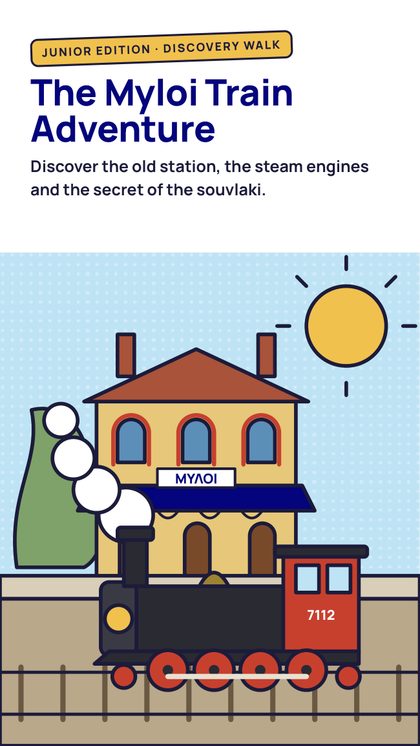
Discovery walk · pdf
The Myloi train adventure
Eight stops around the old station, with search tasks and a medal. Did you finish it? Then you get a free cut-out model of the station at the kiosk in the village.
Please note: the paper models of the station are out of stock at the moment. New ones are being made as soon as possible.
-
Colouring pages · pdf
Two train colouring pages
The station with a steam engine, and the souvlaki sellers by the train. Print them on A4 and grab your colouring pencils.
-
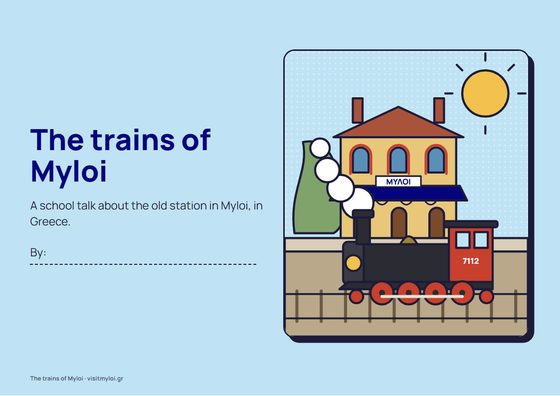
School talk kit · pdf
School talk: the trains of Myloi
A cheat sheet and slides for the interactive whiteboard, ready to use.