
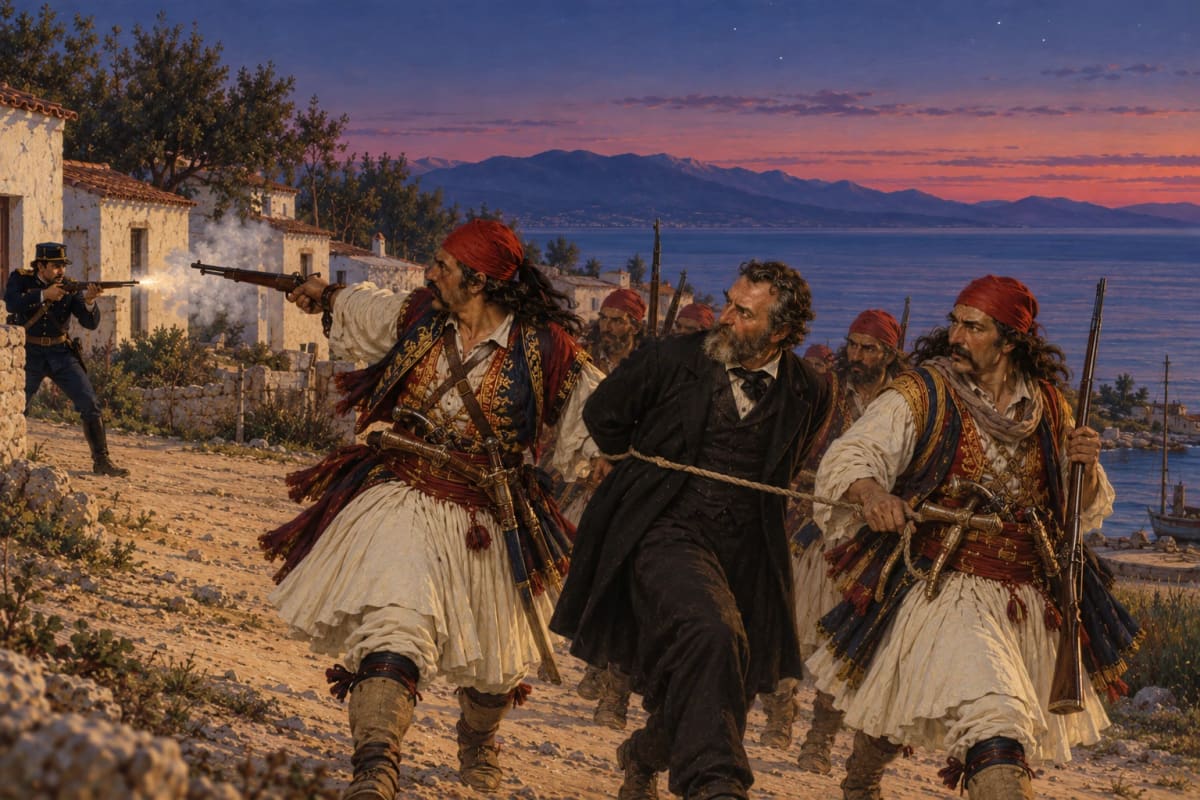
On a spring evening in 1864 a band of brigands burst into Myloi. They robbed the deputy mayor's house, killed two men and led the deputy mayor away into the night with his hands tied. The newspapers of the time tell us what happened, and how it ended.
A deputy mayor who welcomed a king
Six years earlier, in March 1858, Loukas Giannakopoulos had his great day. King Otto and Queen Amalia came from Nafplio to Myloi on the steamship Sfendoni. As the village's deputy mayor (πάρεδρος), Loukas had the streets strewn with myrtle and a triumphal arch built. The whole village turned out with music, and the royal couple visited the state ironworks, which ran on the water of the springs.
Myloi was then a small village in the municipality of Argos: a few houses and shops, the mills and the works. These were restless years. In 1862 King Otto had been driven out, and in the chaos that followed many prisoners went free and bands of brigands roamed the Peloponnese.
When the lamps were lit
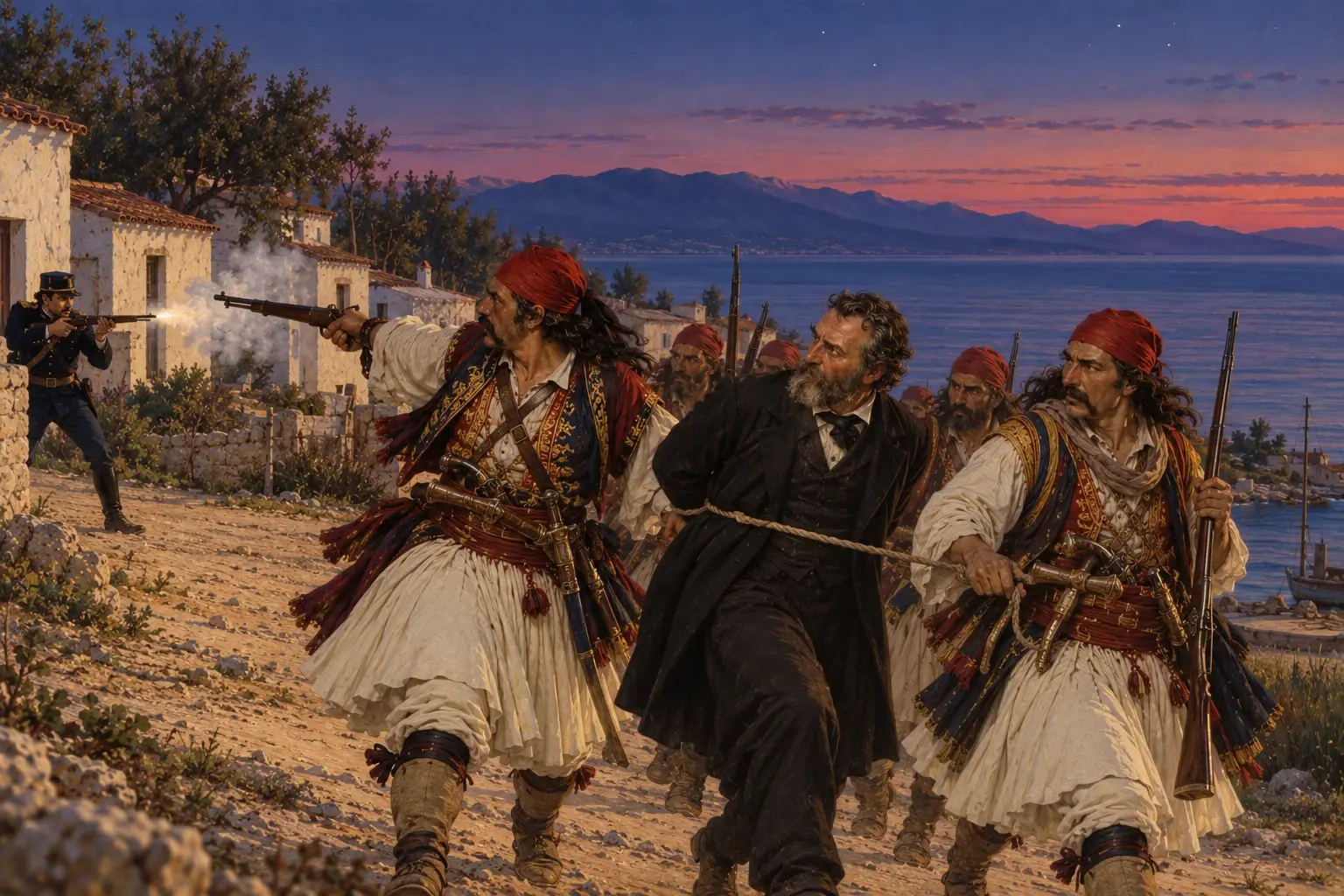
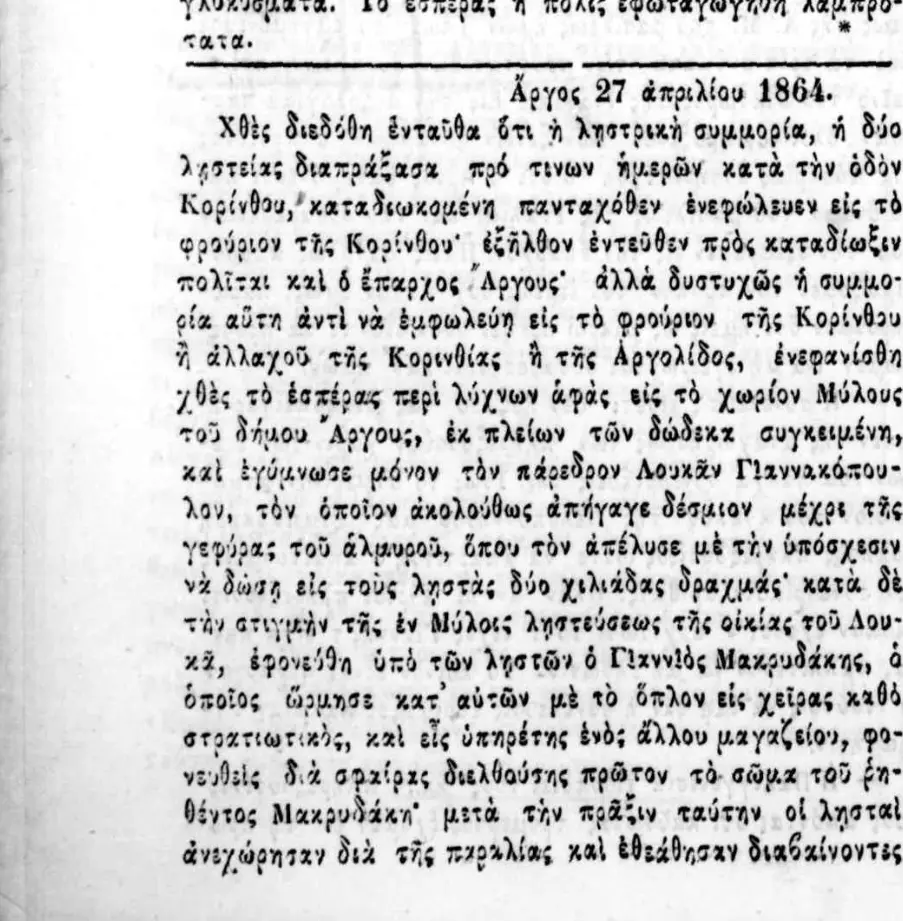
On 26 April 1864 in the old calendar, 8 May in ours, a band of more than twelve brigands appeared in Myloi "when the lamps were lit". They went straight to the deputy mayor's house. There they found only 800 drachmas in coin. That was not enough for them, so they took Loukas himself, his hands bound.
A soldier and a runner
Makrydakis, a soldier who was probably the corporal at the ironworks, went for the brigands with his rifle. He was shot dead. The bullet passed right through him and also killed a servant from one of the shops. According to another newspaper, Makrydakis had probably wounded one of the brigands first.
Meanwhile a villager, Andreas Thliveras, ran to Argos to raise the alarm. In Argos the church bells rang. Cavalry saddled up and fifty armed citizens marched to Myloi. Kiveri was warned too. But by the time help arrived, the brigands were long gone.
To the bridge
The band fled along the coast, with Loukas bound in their midst, as far as the bridge over the Almyros. There they let him go, on his promise to pay them 2,000 drachmas, a fortune at the time. Whether he ever paid it, no newspaper says.
The next day the investigation began. A few villagers and shepherds were arrested on suspicion of helping the brigands. To everyone's surprise, the man who until a few days earlier had been the priest of Myloi and Skafidaki was arrested too. By January 1866 he was free again and serving as a priest in Argos. We have found no conviction anywhere, so we do not give his name.
The band of Lykos
Who were the brigands? A few weeks later a cadet of the military academy was kidnapped near Piraeus. Released for a ransom, he said he had been held by the brigand chief Lykos, "the same who recently committed the robbery at Myloi and has twelve followers".
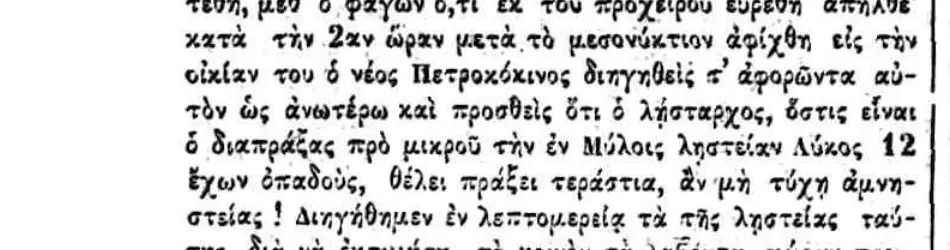
Lykos's real name was Georgios Lyngos, from Cheli, a mountain village on the border of Argolis and Corinthia. He was an old brigand who had once been pardoned by King Otto, and who took to the mountains again after Otto's fall, when he was already past sixty. In December 1864 a royal decree listed him as a first-class brigand, with a reward of 3,000 drachmas "for his arrest or death". In 1865 a member of parliament asked why nobody arrested the brigand Lyngos, "who is hiding by the lake of Lerna", right next to Myloi.
How it ended
In 1865 members of the band were arrested near Nafplio. Their trial was moved to Syros, because Lyngos was threatening witnesses and jurors with death from his hiding place in the mountains. In June 1866 several of the band, among them his nephew, were sentenced to death there. Whether the raid on Myloi was one of the cases tried, the reports do not say.
Lyngos himself was never caught. According to the newspapers he was killed near Dimitsana in 1868 by one of his own men, although the reports contradict each other. Myloi remained an unsafe place for years: in 1867 the newspaper Η Αργολίς still called the village "dangerous to public safety". The earliest police post in Myloi that we know of dates from 1889.
Sources
- Βελτίωσις (Tripoli), 11 March 1858: the visit of King Otto and Queen Amalia.
- Παλιγγενεσία (Athens), 30 April 1864 p. 4 (letter from Argos of 27 April), 5 May 1864 p. 3, 18 December 1864 p. 4 and 28 January 1866 p. 4.
- Νομιμόφρων, 4 May 1864 p. 4 and 14 May 1864 p. 4; Αρκαδία (Tripoli), 4 May 1864 p. 2; Αυγή, 13 May 1864 p. 3.
- Κλειώ (Trieste), 27 October 1865 p. 3; Ερμούπολις (Syros), 15 June 1866 p. 1; Πατρίς (Syros), June–July 1866.
- Η Αργολίς (Nafplio), 1867; Αυγή, 7 November 1868; Παλιγγενεσία, 15 September 1869.
- All newspapers: Library of the Hellenic Parliament. Dates in the old (Julian) calendar. Quotations translated by Visit Myloi from our own reading of the scans.
- The illustration at the top is an imagined scene made with AI. No pictures of the raid itself exist.