
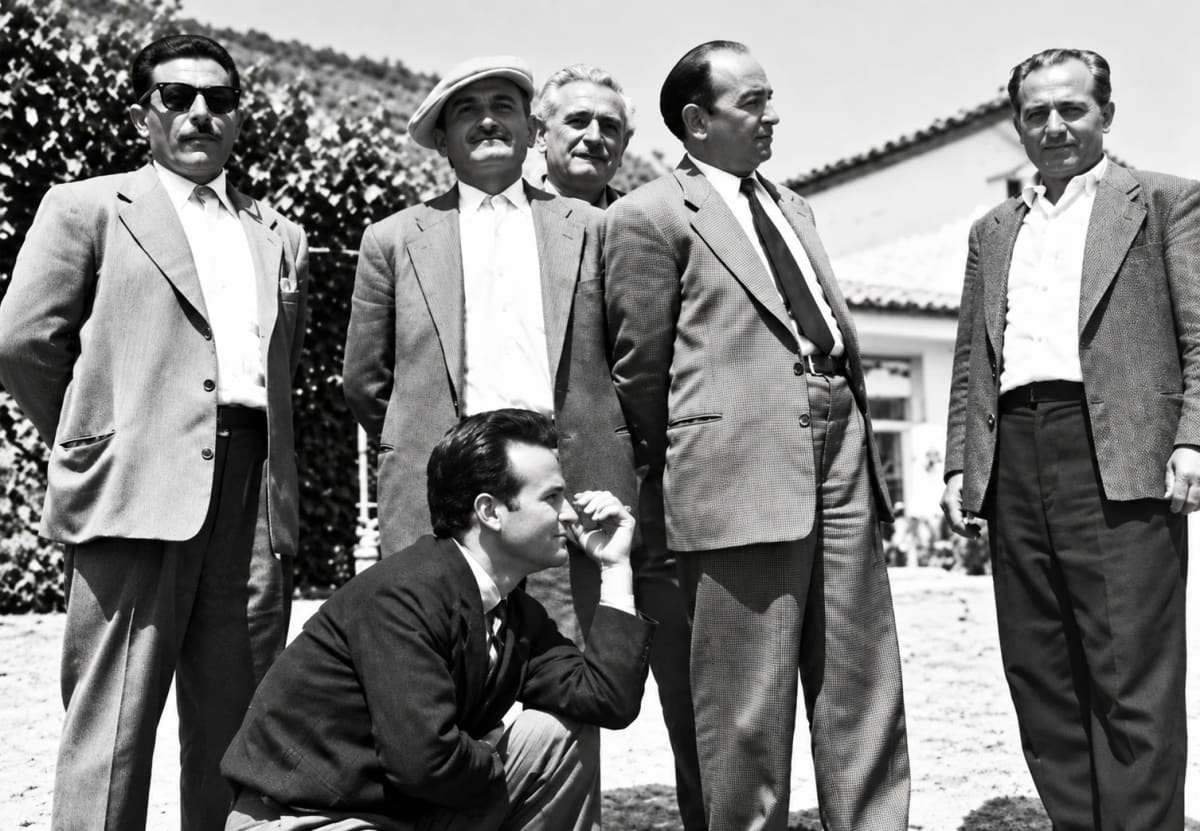
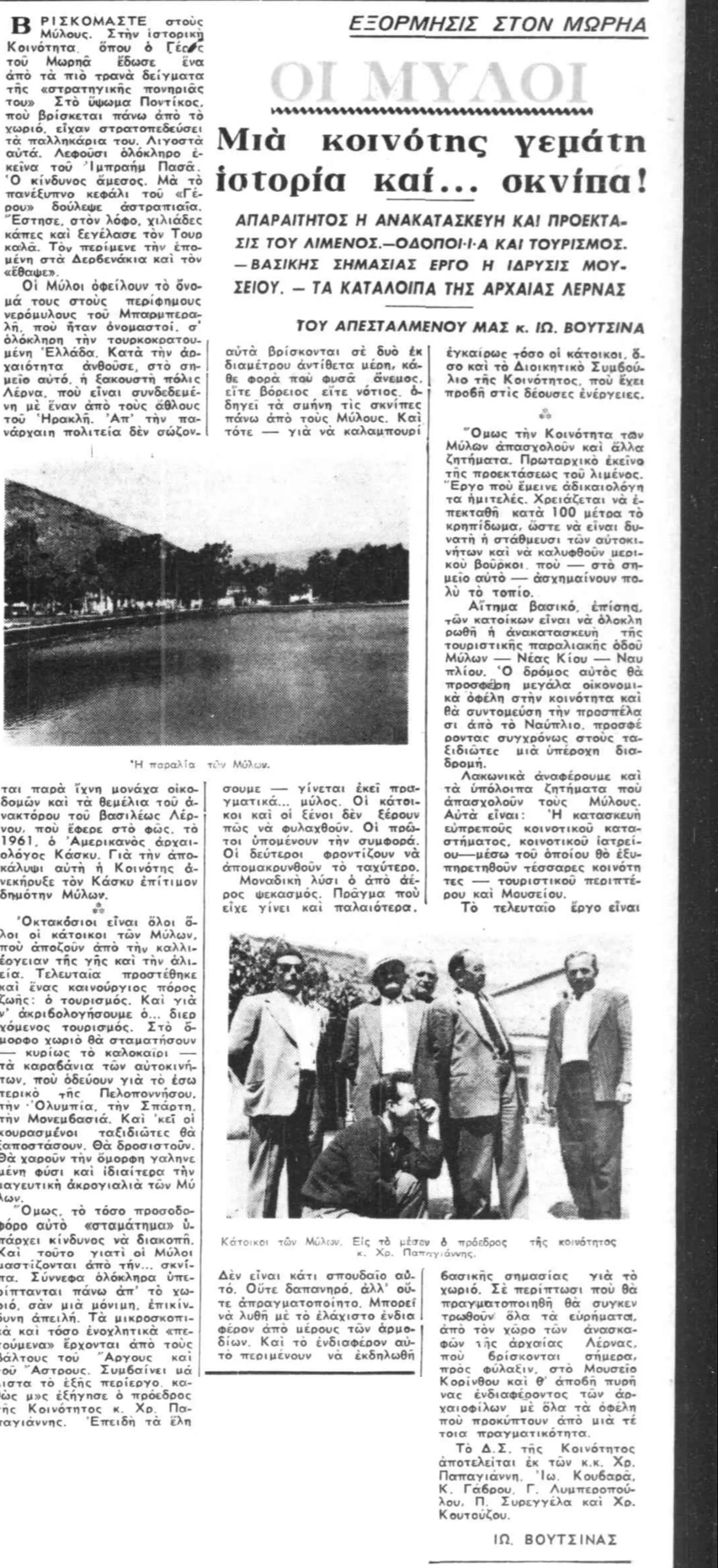
On 14 November 1963 the Athens evening paper Βραδυνή devoted a full report to our village. Its correspondent, Ιω. Βουτσινάς, called it "a community full of history and… gnats!". Sixty years on, here is the original article as it was printed, with a full translation.
The article in translation
A faithful translation of the newspaper text. Our explanations are in square brackets.
ON THE ROAD IN THE MOREA · MYLOI
A community full of history and… gnats!Rebuilding and extending the harbour is essential. — Road building and tourism. — A project of basic importance: founding a museum. — The remains of ancient Lerna
From our correspondent Ιω. Βουτσινάς
WE ARE in Myloi. In the historic community where the Old Man of the Morea [Kolokotronis] gave one of the finest displays of his "strategic cunning". On the hill of Pontikos, above the village, his fighters had made camp. There were few of them. Ibrahim Pasha's men were a whole army. The danger was immediate. But the "Old Man's" brilliant mind worked at lightning speed. He set up thousands of shepherds' capes on the hill and fooled the Turk thoroughly. The next day he lay in wait for him at Dervenakia and "buried" him.
Myloi owes its name to the famous watermills of Barberalis, renowned throughout Turkish-occupied Greece. In antiquity the celebrated city of Lerna flourished on this spot, linked to one of the labours of Heracles. Of the ancient city only traces of buildings survive, and the foundations of the palace of King Lernos, which the American archaeologist Caskey brought to light in 1961. For this discovery the community declared Caskey an honorary citizen of Myloi.
Myloi has eight hundred inhabitants in all, who live from farming and fishing. Recently a new livelihood was added: tourism. Or, to be precise,… passing tourism. In the pretty village – mainly in summer – the caravans of cars heading for the interior of the Peloponnese stop on their way to Olympia, Sparta and Monemvasia. There the tired travellers rest, cool off and enjoy the lovely, peaceful countryside and above all the enchanting beach of Myloi.
But this so profitable "stop" is in danger of ending. For Myloi is plagued by… the σκνίπα [tiny biting gnats]. Whole clouds hover over the village, like a permanent, dangerous threat. The minute and so troublesome "flyers" come from the marshes of Argos and of Astros. And something curious happens, as the president of the community, Mr Chr. Papagiannis, explained to us. Because these marshes lie in two diametrically opposite places, every time the wind blows, whether from the north or the south, it drives the swarms of gnats over Myloi. And then – if we may joke – it really becomes a… mill [μύλος, also "madhouse"]. Residents and visitors do not know how to protect themselves. The former endure the plague. The latter make sure to leave as quickly as possible.
The only solution is spraying from the air. This has been done before. It is nothing remarkable. Neither costly, nor impracticable. It can be solved with the slightest interest from the authorities. And both the residents and the community council, which has taken the necessary steps, hope to see that interest shown in good time.
But the community of Myloi has other concerns too. First among them is the extension of the harbour, a project left unfinished without good reason. The quay needs to be extended by 100 metres, so that cars can park and some muddy pools, which badly spoil the landscape at this spot, can be covered.
Another basic request of the residents is the completion of the rebuilding of the coastal tourist road Myloi – Nea Kios – Nafplio. This road will bring the community great economic benefits and shorten the journey from Nafplio, while offering travellers a wonderful route.
Briefly, we list the other issues that concern Myloi: the building of a decent community office, of a community doctor's surgery – which will serve four communities – of a tourist pavilion and of a museum.
This last project is of basic importance for the village. If it is realised, all the finds from the excavation site of ancient Lerna, now kept for safekeeping in the Corinth Museum, will be brought together there. It will become a source of interest for lovers of antiquity, with all the benefits that follow from such a reality.
The community council consists of Messrs Chr. Papagiannis, Io. Kouvaras, K. Gavros, G. Lymperopoulos, P. Syrengelas and Chr. Koutouzos.
Ιω. Βουτσινάς
Captions: "The beach of Myloi." — "Residents of Myloi. In the middle the president of the community, Mr Chr. Papagiannis."
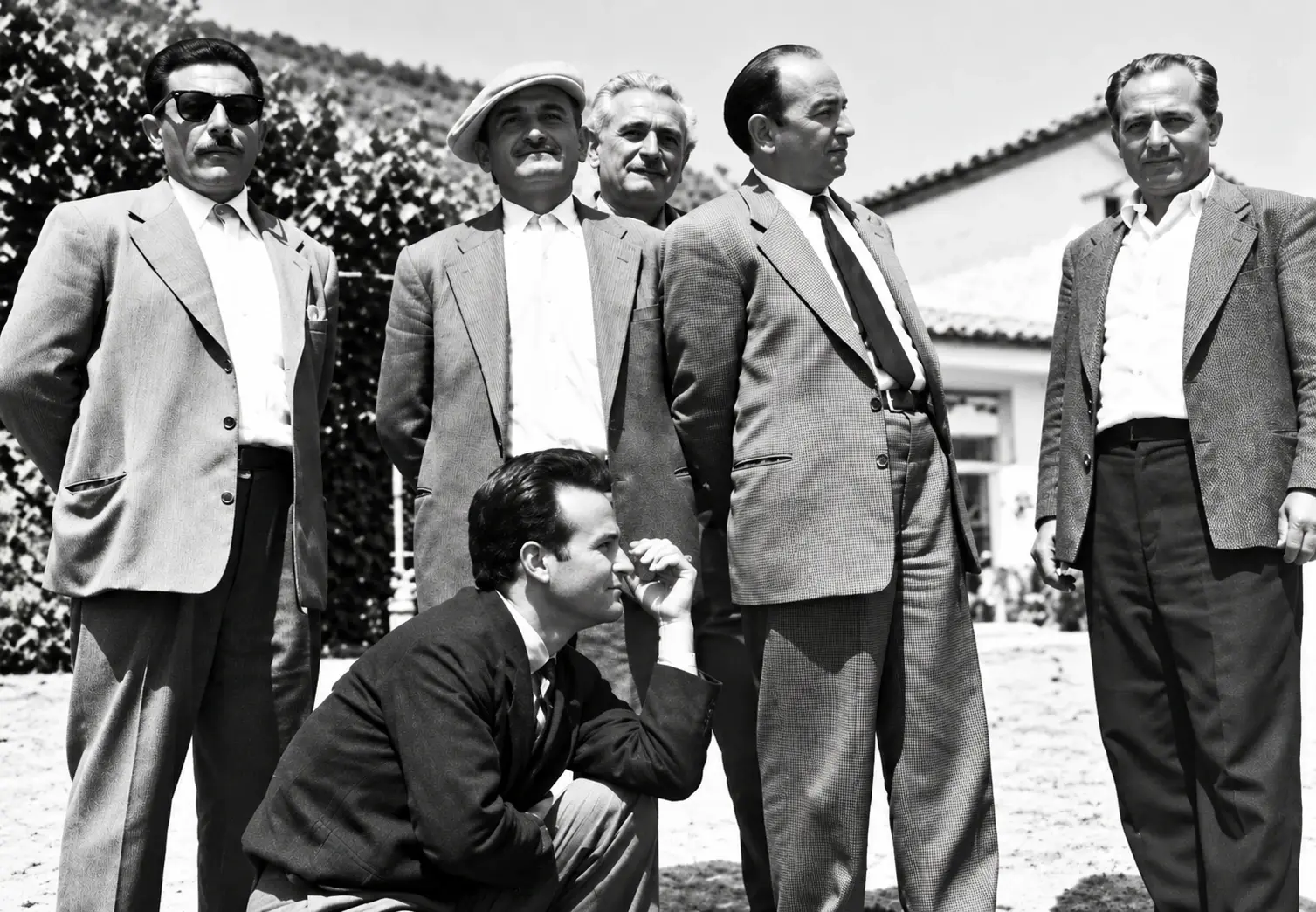
The group photo carries only the caption "Residents of Myloi. In the middle the president of the community, Mr Chr. Papagiannis". The six men may well be the president and his five councillors, but the paper does not say so. Do you recognise anyone? Let us know on Facebook, and we will add the names.
Editor's note
- The paper mixes up two events. At Dervenakia (July 1822) Kolokotronis defeated the army of Dramalis, not of Ibrahim. Ibrahim Pasha only came to the Peloponnese in 1825; it was then that Makrygiannis and Dimitrios Ypsilantis stopped him at Myloi.
- Caskey excavated at Lerna from 1952 to 1958, not in 1961. Archaeologists call the large building he found the "House of the Tiles", from the Early Bronze Age; it is not the palace of a King Lernos.
- We reproduce the article as it was printed. The errors of the time are left in place and explained here.
Source
- Η Βραδυνή (Athens), 14 November 1963, p. 3: Ιω. Βουτσινάς, "ΟΙ ΜΥΛΟΙ. Μιά κοινότης γεμάτη ιστορία καί… σκνίπα!". Digital Library of the Hellenic Parliament: read the complete newspaper.
The article is shown as a facsimile; the advertisements around it have been left out. The group photo has been digitally restored from the newspaper print, so details of the faces may differ from the original. The newspaper no longer exists; should you hold the rights, please contact us.