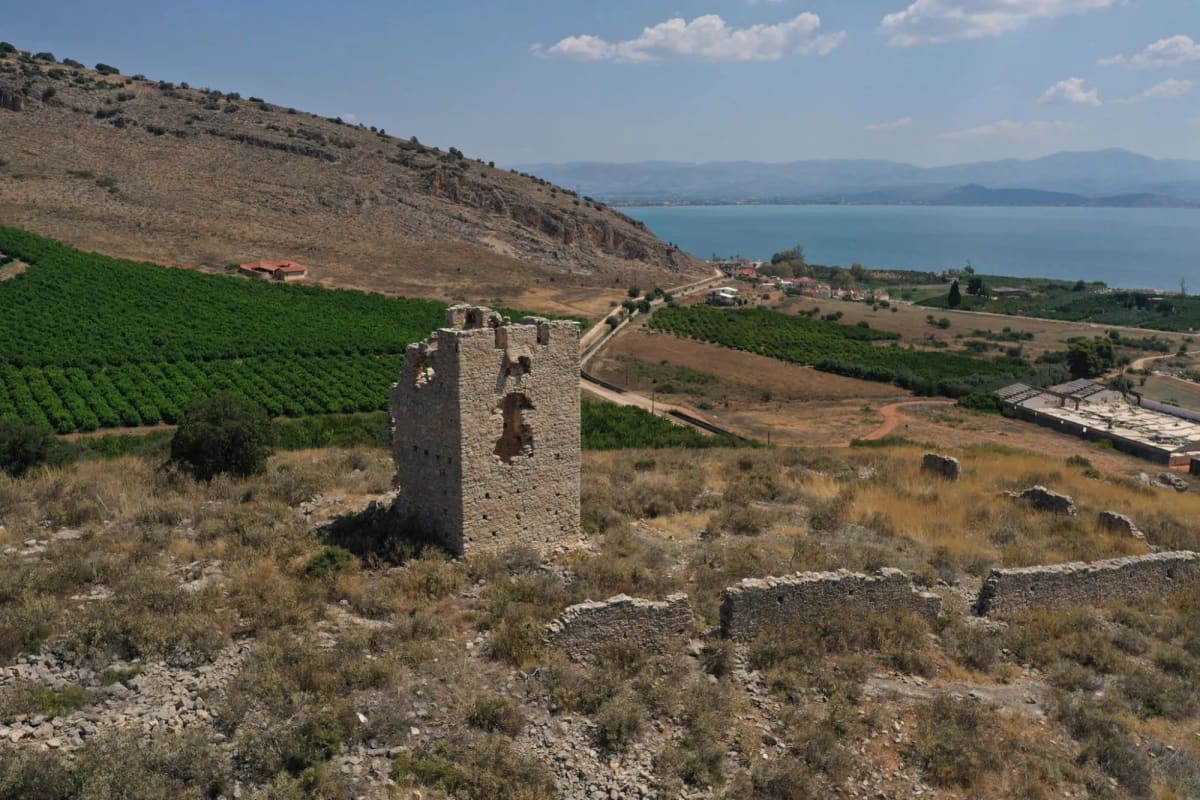
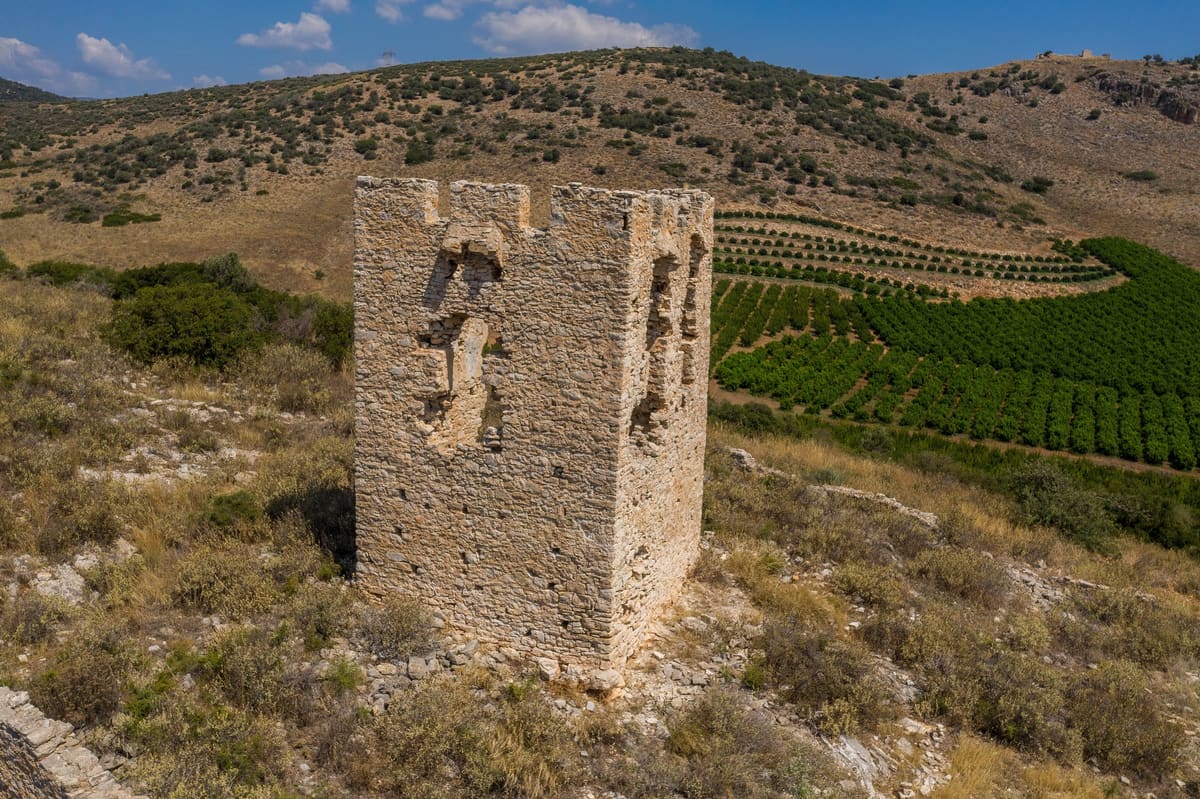
A lonely medieval tower on a ridge south of Myloi, with a legend about a princess and a secret passage to the sea.
Legend
The legend
People in the area call it the Tower of the Princess, “o pyrgos tis Vasilopoulas”. The story goes that a princess lived here long ago. Because of her great beauty (others say, her great ugliness) she had a passage dug from the tower down to the shore, so that she could go and bathe in the sea unseen.
History
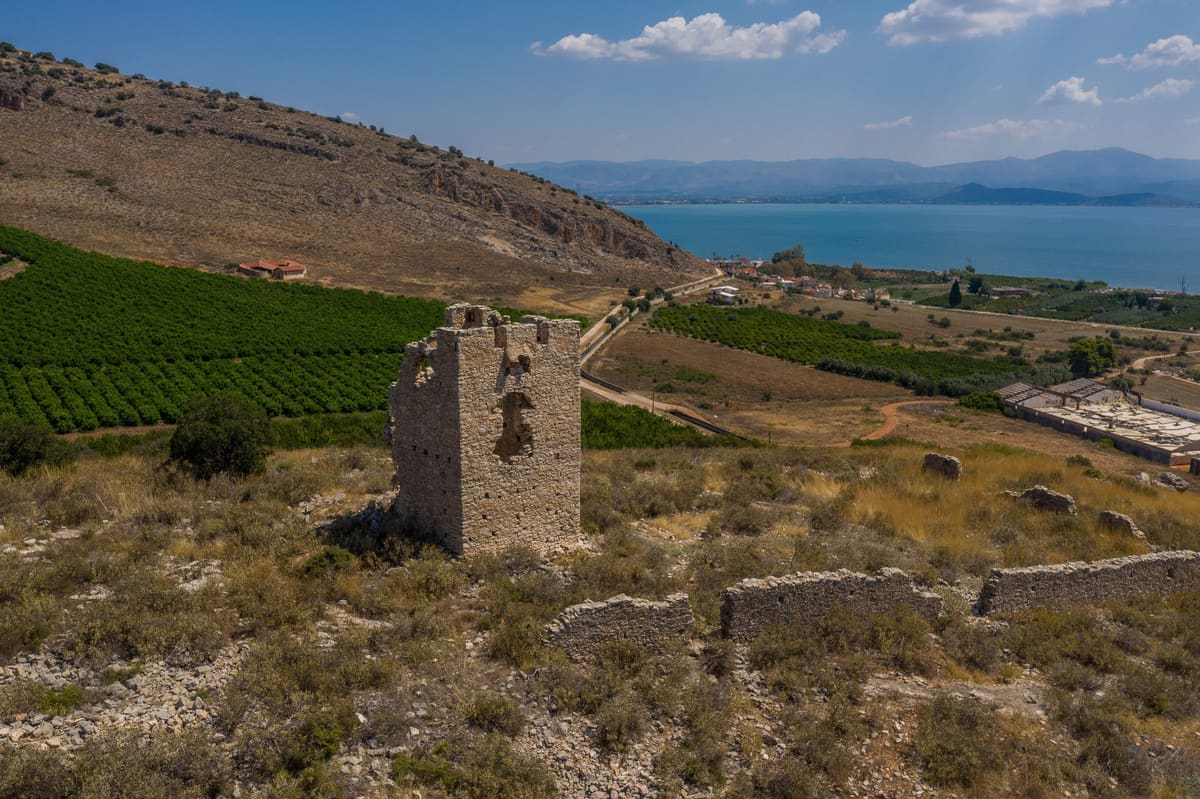
The tower stands about half a kilometre south of the village, close to the coastal road towards the southern Peloponnese, on a long flat spur about 74 metres above the sea. It is also called the tower of Kiveri, after the old village of Kiveri that once lay nearby; today's Kiveri is on the coast, about 6 km further south.
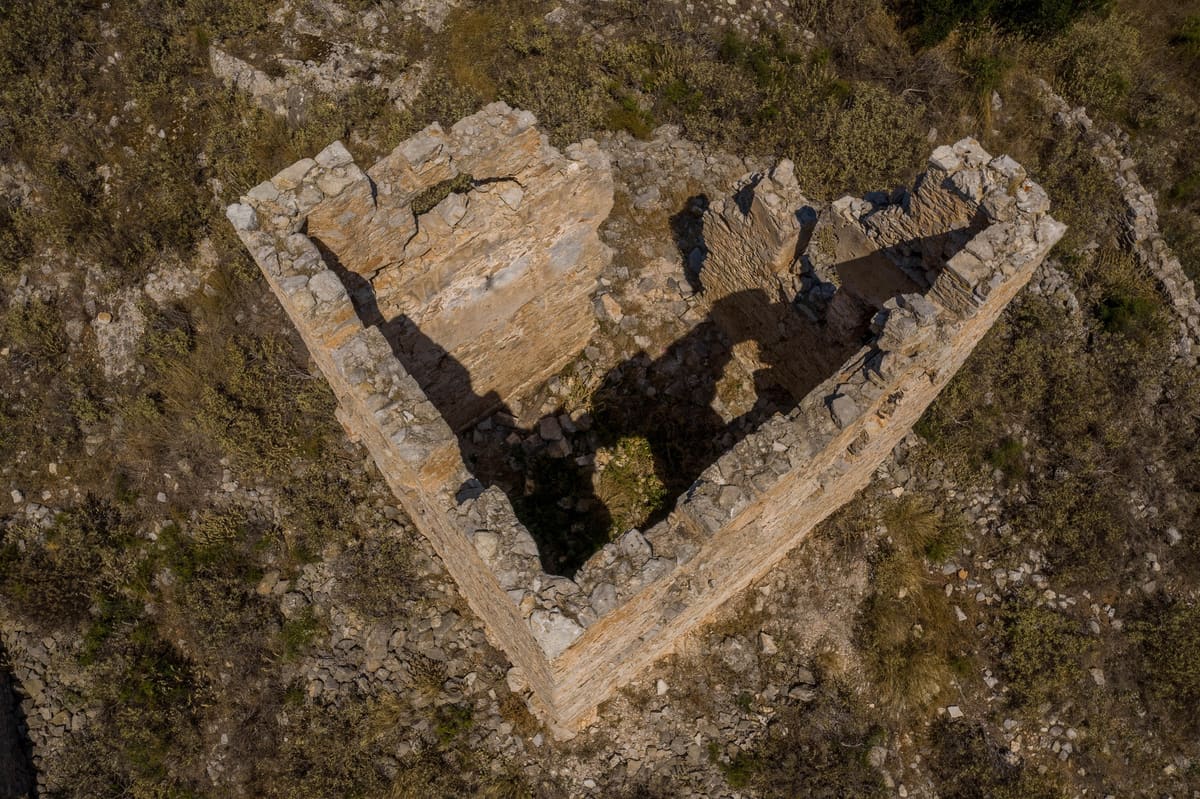
The tower stands within a nearly rectangular walled court of about 20 by 60 metres. It had a ground floor, an upper floor and a roof terrace that still keeps its merlons and the narrow openings at the corners for weapons. The entrance was probably on the west side, but the wall has collapsed there, so it is not clear whether it was at ground level or on the floor above.
The upper floor had large windows, one each on the north and south, two on the east and probably one on the west, protected by small overhanging defences of which three survive. Inside, the walls of the upper floor are still plastered and have built-in cupboards: this was the living space, while the ground floor served for storage and animals. The tower is built of rough-hewn and field stones with plenty of mortar; the different masonry of the enclosure wall suggests that it was built at another time.
Its date is uncertain. It is usually considered a Frankish tower of the 13th or 14th century, although some scholars have thought it Ottoman. In its plan it resembles the fortified farmsteads of the medieval Aegean islands.
Source: Visit Myloi concept text; D. W. McLeod, Hesperia 31 (1962); Ephorate of Antiquities of Argolida (argolisculture.gr)
The tall stone Vasilopoula tower among vineyards in the hills south of Myloi Photo: Fred Kok
The tower and the remains of its enclosure wall, with the sea behind Photo: Fred Kok
The roofless tower seen from directly above Photo: Fred Kok