
Myloi is a charming seaside village in the region of Argolida, in the northeastern Peloponnese. Its name, which means “mills” in Greek, reflects its past as an area rich in water-powered flour mills, thanks to the nearby springs of ancient Lerna. Nestled between the mountains and the Argolic Gulf, Myloi combines natural beauty with historical depth. The village is built near the site of ancient Lerna, known from mythology as the home of the Lernaean Hydra, and rich in archaeological significance. You can still see ruins from different periods, including a Venetian wall, two old train stations, and the nearby medieval castle on Pontinos. Today, Myloi remains a peaceful fishing village, with tavernas lining the waterfront and locals gathering at the pier in the evenings. Its relaxed atmosphere, scenic views, and layered history make it a perfect stop for walkers, history lovers, and travelers alike. This walking route has been created and is offered by Visit Myloi.
1) Starting point: the lighthouse
The hike begins at the pier and lighthouse of Myloi, offering stunning views over the Argolida Bay. This peaceful spot is more than just a starting point — it’s a favorite gathering place for locals, especially on warm summer evenings. Villagers and young people often come here to socialize, watch the sunset, or celebrate special occasions. It’s not uncommon to witness a beautiful wedding reception unfolding by the water. Right next to the pier, you’ll find local tavernas serving freshly caught fish — often the very same fish that swam in the bay earlier that morning. It’s an ideal place to enjoy a leisurely lunch before or after your walk, with the sea breeze and scenic backdrop adding to the experience.
2) Lerna springs
As you walk along the river’s path toward the sea, you’re following in ancient footsteps. This area, known as Lerna, lies near the village of Myloi on the eastern Peloponnese coast. In classical times, Lerna was famed for its fresh springs and the now-vanished Lake Lerna, once believed to be a mystical gateway to the underworld. It is here that mythology places the fearsome Lernaean Hydra—slain by Heracles in his second labor. Along the way, imagine the life that once flourished here. Archaeological findings reveal that Lerna was inhabited as early as the Neolithic period. One remarkable site is the “House of the Tiles,” a large Early Bronze Age building with some of the earliest known clay roof tiles in Greece. This was also a sacred place. Ancient rites known as the Lernaean Mysteries, dedicated to the goddess Demeter, were held here, near the dark waters of the Alcyonian lake—once thought to be bottomless. Although the lake has long disappeared, the myths and spiritual aura still linger in the landscape. Walking beside the river, toward the open bay, you’re tracing a path through one of Greece’s oldest stories—where history, legend, and nature flow together.
3) The Σ.Μ.Ε. station
As you follow the walking route through Myloi, you’ll pass a particularly charming and historic part of the village: the old railway stations. Myloi is unique in that it has two old train stations, each telling a different story from Greece’s railway past. The smaller of the two, a modest building of the Southern Greece Railways (Σ.Μ.Ε.), was the ticket office of the company that ran the line to Tripoli and Kalamata. It served only until 1891, when the company was taken over, and stands as a rare reminder of the early days of rail transport in the region.
4) Main Myloi Station
Just a short distance away stands the main station of the Piraeus–Athens–Peloponnese Railways (Σ.Π.Α.Π.), a two-storey third-class station with the ticket office and waiting room downstairs. Around it you can still see the goods warehouse and the small café building that served passengers waiting for their train. The railway reached Myloi from Argos on 4 August 1886, and the line inland to Tripoli opened on 1 February 1892. Though silent today, these stations offer a glimpse into the days when Myloi was a lively hub of travel and trade.
5) Locomotive shed (remise)
A little further along the tracks stands the locomotive shed (remise), built in 1886: a large stone building with two long halls where the trains of the line to Tripoli and Kalamata were kept, and the most remarkable building of the station. Though now quiet, it reflects Myloi’s past as a lively and strategic rail junction.
6) Church of the Holy Apostles
Along the walking route through Myloi, you’ll come across the Church of the Holy Apostles (Εκκλησία Αγίων Αποστόλων), the parish church of the village. This Orthodox church is dedicated to the Twelve Apostles and reflects the strong religious tradition of the area. The large white church, with its two bell towers and red domes, stands in the heart of the village, close to the old railway station. It plays a central role in the life of the local community, especially during the annual celebration of the Holy Apostles on June 30th. Whether you visit during a service or simply pause outside, the church offers a moment of calm and reflection within your walk—connecting the natural beauty of the surroundings with the village’s living traditions and quiet devotion.
7) Castle on Pontinos
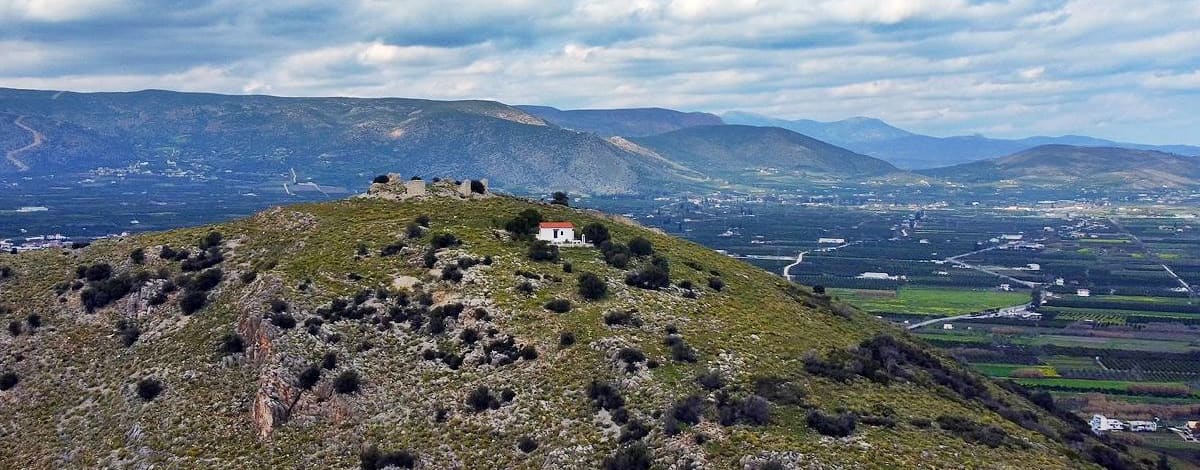
Perched atop Pontinos Hill, about 300 meters west of the village, the castle offers a striking glimpse into the region’s medieval past. Built between the late 13th and early 14th centuries during the Frankish occupation, the castle occupied a strategic position with sweeping views over the Argolic Gulf. Its location made it ideal for monitoring sea routes and defending the surrounding area. Originally known by several names, including Kastro Lernis and Kastro Kiveriou, the castle is characterized by its thick stone walls, adapted to the rocky terrain. Though much of the structure now lies in ruins, parts of the walls and foundations still remain. As you walk through this quiet site, you can imagine its past as a fortified lookout and a center of local power. The panoramic views from the hill make it not only a historical stop, but also a breathtaking one.
8) Church of the Prophet Elijah
Right next to the castle stands the Church of the Prophet Elijah—a small, modest chapel perched on the hilltop. It’s the perfect spot for a peaceful lunch break, with breathtaking views over the bay and the fertile plains of Argolida spread out below. The church is especially significant on July 20th, when the name day of Prophet Elijah is celebrated. Like many chapels dedicated to him in Greece, it’s built on high ground, symbolizing the prophet’s connection with the heavens. On this day, locals often gather here for a special service, followed by small festivities in honor of the saint. After taking in the view and a moment of rest, the trail begins its gentle descent back toward the village—offering one last panorama before you return to sea level.
9) Church of Saint Demetrios (Άγιος Δημήτριος)
On the southern edge of Myloi, near the cemetery and the springs of Lerna, stands the Church of Saint Demetrios (Άγιος Δημήτριος). Modest and serene, this church holds a special place in the lives of local families, as it is where many of Myloi’s ancestors are laid to rest. The church is dedicated to Saint Demetrios, one of the most revered saints in the Orthodox tradition. His name day is celebrated on October 26th, often marked by a quiet but meaningful service attended by villagers who come to honor both the saint and their loved ones.
10) Honoring General Giannis Makriyannis (1797–1864)
In the center of Myloi stands a bust honoring General Giannis Makriyannis (1797–1864), a pivotal figure in the Greek War of Independence. Born Ioannis Triantaphyllou, Makriyannis rose from humble beginnings to become a celebrated military leader, politician, and author. His leadership was instrumental during the Battle of Myloi on June 13, 1825, where, despite limited resources, he and his men successfully defended the village against the advancing Egyptian forces under Ibrahim Pasha. This victory was crucial in preventing the fall of Nafplio and sustaining the momentum of the Greek revolution. Beyond his military achievements, Makriyannis is renowned for his “Memoirs,” written in Demotic Greek, offering invaluable insights into the era and earning acclaim as a monument of modern Greek literature. The bust in Myloi serves as a tribute to his enduring legacy and the profound impact of his actions on Greece’s path to independence.