Springs that never run dry, a lake without a bottom and a monster with many heads: the ancient Greeks told more stories about Lerna than about almost any other spot in the Argolid.
Everything on this page is legend. The ancient authors who recorded each story are named, so you can read them yourself.
Legend
Heracles and the Hydra
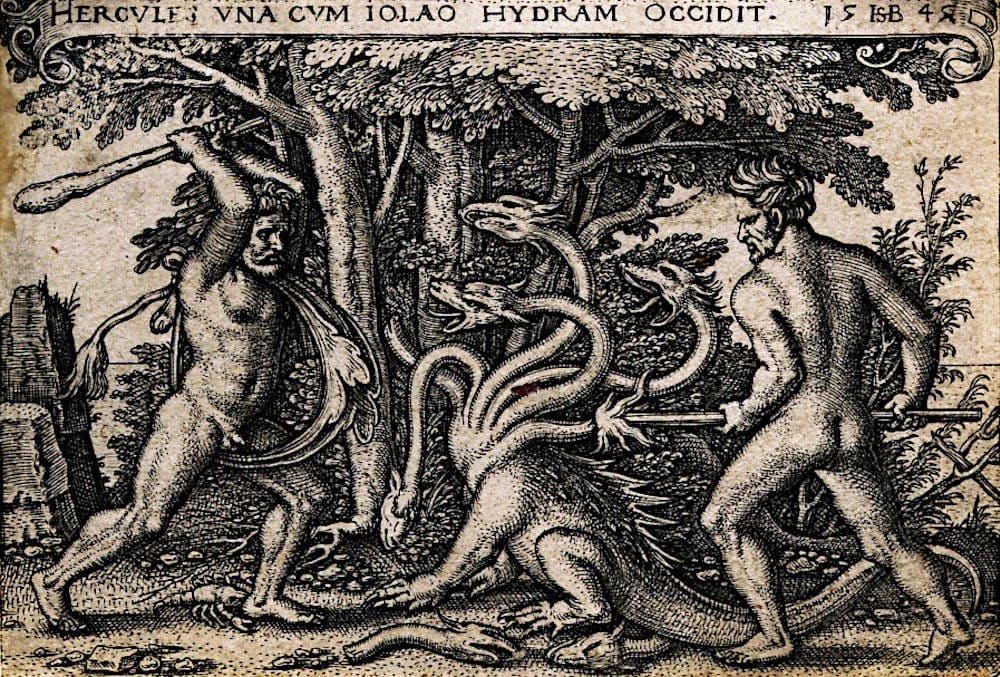
In the marshes of Lerna lived the Hydra, a water serpent with many heads, one of them immortal. For his second labour, King Eurystheus sent Heracles to kill it.
Heracles drove the beast from its lair with burning arrows and began to club off its heads, but for every head he struck off, two grew back. His nephew Iolaos set the nearby woods alight and seared each neck with a torch so that no new heads could grow. Heracles cut off the immortal head, buried it under a heavy rock by the road, and dipped his arrows in the Hydra's poison.
Eurystheus refused to count the labour, because Heracles had been helped.
Ancient source: Apollodorus, Library 2.5.2; Hesiod, Theogony 313–318
Legend
Amymone and the springs
When the Argolid lay parched, Danaus sent his daughters to look for water. Amymone, one of them, threw a spear at a deer and hit a sleeping satyr, who attacked her. Poseidon appeared and saved her, and struck the rock with his trident. Water sprang up: the springs of Lerna, which never ran dry again.
Ancient source: Apollodorus, Library 2.1.4; Pausanias 2.37.1, 2.37.4
Legend
The Danaids
The fifty daughters of Danaus were forced to marry the fifty sons of Aegyptus. On the wedding night all but one killed their husbands. The story says they buried the heads of the young men at Lerna.
Ancient source: Apollodorus, Library 2.1.5
Legend
The Alcyonian lake and the mysteries
Near the springs lay the Alcyonian lake, said to have no bottom. Through it, the Argives believed, Dionysus went down to the underworld to bring back his mother Semele. Pausanias tells how the emperor Nero had the depth sounded with long ropes and found no bottom, and that the calm water drew down anyone who tried to swim across.
In a sacred grove of plane trees, mysteries were held in honour of Demeter. Pausanias says he was not allowed to tell what happened at the night-time rites.
Ancient source: Pausanias, Description of Greece 2.37.1–2.37.6