
Photo: Courtesy of Harvard Fine Arts Library, Digital Images & Slides Collection
History & Mythology
Ancient Lerna
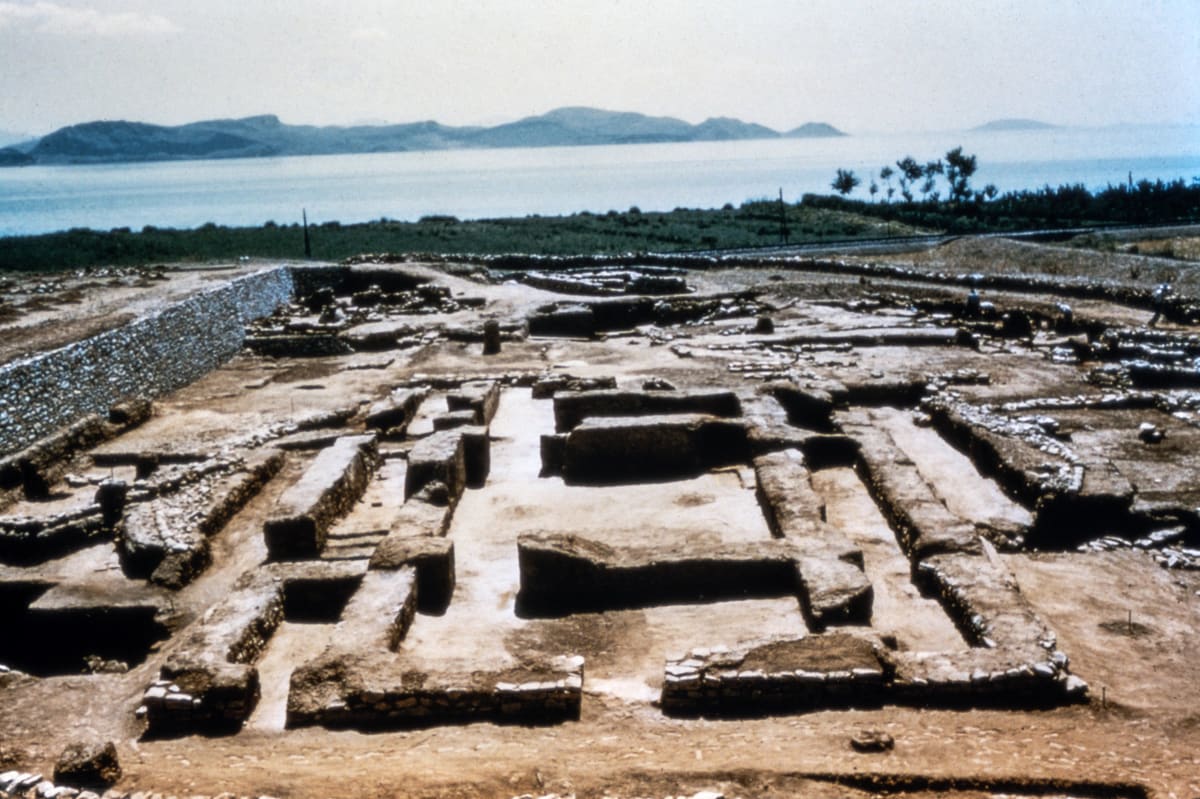
Just south of the village, by the springs, lies one of the most important prehistoric sites in Greece.
Lerna is a low settlement mound by the springs that fed the ancient lake. People lived here from the Neolithic period to the Mycenaean era. Because each generation built on the remains of the last, the mound preserves a long sequence of layers that has helped archaeologists date the Bronze Age of mainland Greece.
The best-known building is the House of the Tiles, a large Early Bronze Age structure of about 2500–2200 BC, roofed with baked clay tiles and stone slabs. It was destroyed by fire and never rebuilt. Rows of seal impressions found in it show that goods were stored and controlled here, which suggests the building had an administrative role.
Lerna stayed inhabited into the Middle Bronze Age. In the Mycenaean period (about 1600–1200 BC) the hill was used as a cemetery and for occasional habitation, and around 1250 BC it was abandoned for good.
The site was excavated between 1952 and 1958 by John L. Caskey for the American School of Classical Studies at Athens. A protective roof was built over the House of the Tiles in 1957, and visitors today follow a path with information panels.